Received an OSHA Citation for an Unprotected Roof Edge? Here’s Exactly What to Do

Disclaimer: We are NOT lawyers and are we are NOT OSHA. This article is designed to assist you as you deal with the next steps following an OSHA citation based on our research. If you have direct questions about your citation, please reach out to OSHA (OSHA.gov) or to your local municipality.
You’re not the first person to get this citation, and you won’t be the last. Take a breath. This is one of the most common OSHA issues, and there’s a clear path to fixing it.
You do have time to resolve it properly, but you need to move quickly and methodically. The worst thing you can do right now is delay or guess your way through it.
1. Understand Your Timeline (This Matters More Than Anything)
Once you receive your OSHA citation by certified mail, the clock starts.
You have 15 business days to take action.
Within that window, you have three options:
- Accept the citation and begin abatement (fixing the issue)
- Request an informal conference with the OSHA area director
- Contest the citation if you believe it’s incorrect
If you do nothing within those 15 days, the citation becomes a final order automatically.
Most companies in your position move forward with abatement. That simply means correcting the hazard that OSHA identified.
If there’s any doubt about the validity of the citation or the penalty, request the informal conference. It doesn’t lock you into anything, and it can buy you clarity, or even reduced penalties.
2. What OSHA Needs to See for Roof Edge Compliance
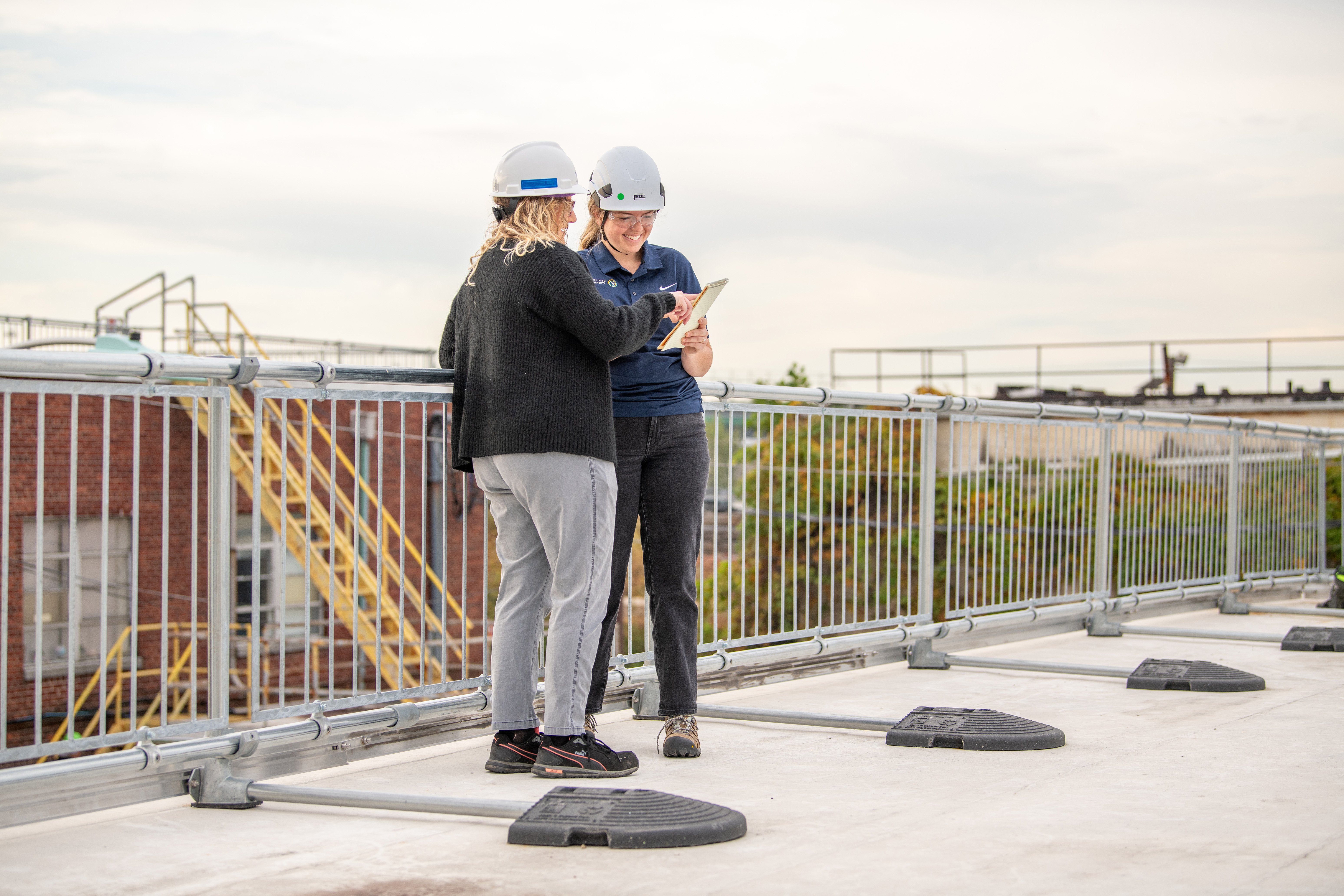
For an unprotected roof edge, OSHA is looking for one thing: a compliant fall protection system.
In most cases, the fastest and most straightforward solution is a guardrail system.
Here’s what that system must meet:
- Top rail height: 42 inches (± 3 inches)
- Mid rail height: 21 inches
- Strength requirement: Must withstand 200 pounds of force applied in any outward or downward direction
Those aren’t suggestions; they’re enforceable standards.
Where companies get into trouble is trying to piece together a solution that looks compliant but isn’t engineered or tested to prove it.
From OSHA’s perspective, documentation matters just as much as the physical fix.
The cleanest way to satisfy both is to use a third-party tested and engineered system. That gives you:
- Verified load ratings
- Standardized installation
- Documentation you can submit with confidence
3. Why Non-Penetrating Guardrail Is the Smartest Move
When time is tight, and it is, you need a solution that installs quickly without creating new problems.
That’s why most facility managers in your position choose a non-penetrating guardrail system.
Here’s why:
No roof penetration
If your roof is under warranty, drilling into it can void coverage. Non-penetrating systems avoid that entirely.
No permits or structural modifications
You’re not altering the building. That removes a major source of delay.
Fast installation
A two-person crew can install up to 600 linear feet in a single day.
Predictable compliance
Systems like KeeGuard are third-party tested and engineered to meet OSHA, ANSI, and IBC standards.
That last point is critical. You’re not just fixing the hazard, you’re building a defensible case that it’s been fixed correctly.
4. How to Document the Fix (Keep It Simple and Complete)

Once your guardrail system is installed, you need to show OSHA that the hazard has been corrected.
Don’t overcomplicate this. They’re looking for clear, verifiable proof.
Include:
1. Photos of the installed system
- Wide shots showing full coverage of the roof edge
- Close-ups of key sections (corners, access points, transitions)
2. Product specifications
- Manufacturer cut sheets
- Proof the system meets the 200-pound load requirement
- Confirmation of compliant rail heights
- What hazard was corrected
- What system was installed
- The date of completion
- Mark your 15-day deadline
- Decide whether to request an informal conference
- Move immediately on a compliant guardrail solution
- Schedule installation as soon as possible
- Collect documentation during and after install
- Submit abatement proof before the deadline
3. A signed statement of correction. A simple written statement confirming:
Submit everything before the abatement deadline listed on your citation.
5. Avoid the Biggest Mistake: Temporary Fixes
It’s tempting to throw up a quick solution just to meet the deadline like warning lines, makeshift barriers, or partial coverage.
That can backfire.
If OSHA determines the fix is inadequate, you’re back where you started—only now under more scrutiny.
6. Why This Cannot Become a Repeat Violation
OSHA doesn’t treat repeat violations lightly.
If the same or a similar hazard is cited again within three years, the penalty can jump to up to $165,514 per violation.
More importantly, it signals a pattern of non-compliance, which can trigger deeper inspections and broader scrutiny across your facility.
This is why the goal isn’t just to “pass” abatement.
The goal is to install a permanent, defensible solution that holds up long-term.
7. What to Do Right Now
Here’s the practical sequence:
8. Get This Handled Quickly and Correctly
You don’t need to navigate this alone.
Simplified Safety can help you select the right KeeGuard configuration for your roof and get it shipped fast, so you can install, document, and submit well before your deadline.
The sooner you start, the more breathing room you have.
Call now and speak with a fall protection expert today. Fix the issue once, document it properly, and move on with confidence.
