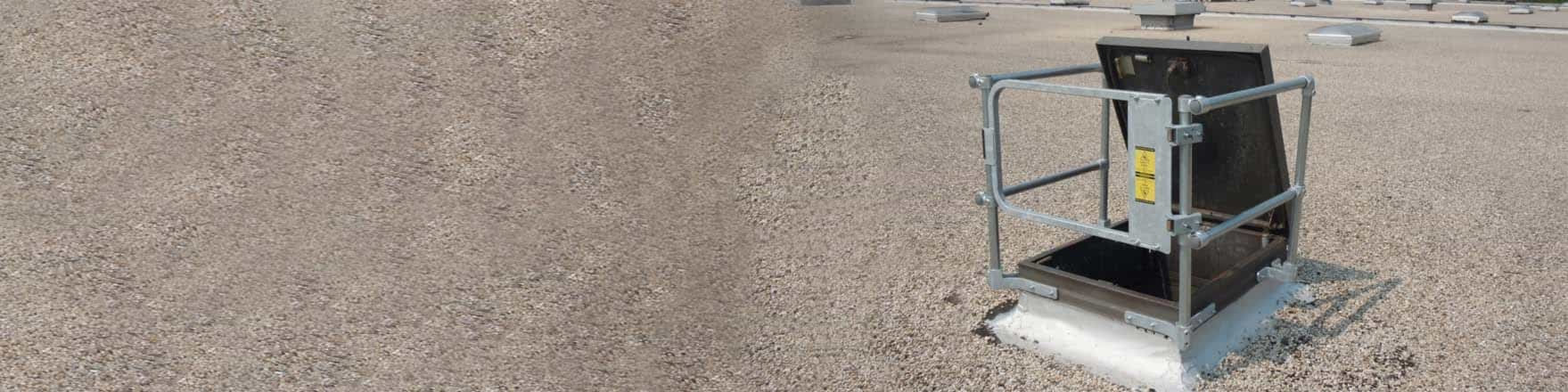
Roof access hatches are one of the most overlooked fall hazards on any commercial or industrial roof. Every time the hatch door is open, there's a wide-open hole in the roof — and OSHA classifies that as a fall hazard that must be protected on all sides. Kee Hatch® is our engineered roof hatch guardrail system: a permanent hatch rail that surrounds the entire opening, integrates a self-closing safety gate at the ladder-access point, and installs without penetrating your roof membrane. It's the same roof hatch safety railing you'll find on Fortune 500 rooftops, water treatment plants, hospitals, schools, and warehouses across North America.
Not every roof hatch railing solves the same problem. Match your hatch to the right Kee Hatch® configuration.
The Kee Hatch RHSR-SS Standard System fits standard rectangular hatches up to about 30" x 54" with full-perimeter guardrail and a self-closing gate.
The RHSR-DL Double Leaf handles wider openings without compromising rail load ratings.
If HVAC, ductwork, or a parapet sits within 24" of the hatch, the RHSR-O Offset extends the footprint to keep workers clear.
The RHSR-FB Forward Barrier is built for hatches on sloped roofs, where standard vertical rail geometry doesn't work.
The RHSR-FV Fire Vent maintains smoke-evacuation function while adding OSHA-compliant fall protection around the perimeter.
The Kee Dome Non-Penetrating Hatch Guardrail uses a freestanding, ballasted design — slightly larger footprint, zero penetrations.
The Kee Hatch Mighty Lite (KHML-SS) is a value-engineered version of the standard system — same OSHA compliance, lighter component set.
Send our fall protection specialists a photo of your hatch and we'll spec the right configuration — free of charge.
Yes. Under OSHA 1910.28(b)(3), an open roof hatch is treated as a floor hole and must be protected. OSHA 1910.29(b) specifies the guardrail must be 42 inches high (±3"), include a midrail, and withstand 200 lb of force on the top rail. The ladder-access side must be protected by a self-closing safety gate — chains and removable bars are not compliant.
None functionally — the terms are used interchangeably in the fall protection industry. Both refer to the OSHA-compliant barrier system installed around the perimeter of a roof hatch to prevent falls when the hatch door is open. "Guardrail" is the term used in the OSHA code itself; "safety railing" is more common in engineering specifications and RFPs.
Yes, if workers enter and exit the roof through the hatch. OSHA 1910.29(b)(13) requires that any opening in a guardrail system used for access be protected by a self-closing gate that swings away from the opening. Kee Hatch® includes an integrated self-closing gate as standard on every configuration.
Yes. Two options: frame-mounted systems bolt to the hatch frame itself, never touching the roof membrane, or the Kee Dome Non-Penetrating Hatch Guardrail is fully freestanding on the roof surface using weighted bases. Both preserve your roof warranty.
Kee Hatch systems start at approximately $2,575 for the Mighty Lite standard system. Standard single-leaf systems typically run $2,600–$3,200. Non-penetrating, offset, forward barrier, double-leaf, and fire-vent configurations range from $3,000 to $5,900+. Installation is not included but is straightforward enough that most facility maintenance teams handle it in-house.
Kee Hatch is manufactured to fit standard hatches from Bilco, Babcock-Davis, JL Industries, Milcor, and other major hatch manufacturers. For non-standard, oversized, or custom hatch openings, we build to spec. Send a photo of your hatch and its dimensions to our fall protection specialists for a same-day fit check.
Yes. Every Kee Hatch configuration is engineered to meet both standards — 1910.28(b)(3) for the floor-hole protection requirement, and 1910.29(b) for guardrail dimensional and load specifications. Documentation is available on request for inspection files.
Homemade guardrails around roof hatches are one of the most common OSHA citation categories for rooftop work. Most fail on one of three points: top rail height (built too low), midrail load rating (untested welds), or missing self-closing gate. Kee Hatch is factory-engineered, load-rated, and comes with the documentation to prove compliance in an audit.
Option available in footer.