The Hidden Safety Challenge in Data Center Construction: Elevated Access & Rooftop Service Paths

Data centers are expanding at a record pace. With the rise of AI, cloud computing, and digital infrastructure, new facilities are being built and existing ones retrofitted at an unprecedented rate. But as server capacity grows, so do the systems that support it.
Behind every rack of servers is a complex web of cooling and power infrastructure that keeps operations stable. Technicians routinely need access to these elevated mechanical systems for maintenance and commissioning.
The challenge? Many sites still rely on improvised, temporary solutions for rooftop access, creating unnecessary safety risks and project delays.
Why Elevated Access Is Becoming a Bigger Challenge
Modern data centers are packed tighter than ever. Every square foot is optimized for computing power, which means mechanical and electrical equipment increasingly occupies rooftop or elevated areas.
At the same time, AI-driven heat loads are pushing cooling systems to work harder. More rooftop chillers and condensers mean maintenance teams are making more frequent trips to elevated service areas.
During commissioning, when systems are being tested and adjusted, improvised access often becomes the norm. Such as ladders leaned against units, scaffold setups, or temporary planks across ductwork. These setups are not only inefficient, they’re dangerous.
The Risks of Improvised Access Solutions
Improvised access methods can seem like a time-saver, but they introduce serious hazards. Temporary ladders and makeshift platforms often fail to meet OSHA requirements, leading to potential violations and safety incidents.
Common hazards include:
- Unsecured ladders or steps leading to rooftop units.
- Tripping risks from loose cabling, ductwork, or uneven surfaces.
- Unguarded edges or narrow walkways put technicians at risk of falling.
Purpose-Built Platforms: The Smart Solution

Engineered access platforms and rooftop walkways are designed specifically to solve these problems. A data center equipment access platform or mechanical access walkway creates stable, repeatable access to elevated areas while meeting OSHA and facility safety requirements.
Key benefits include:
- Safe, stable access to cooling units, air handlers, and electrical systems.
- Faster maintenance and commissioning, since technicians can move freely and confidently.
- Reusable, modular design that adapts as layouts change, ideal for growing or evolving facilities.
Rooftop Platforms and Fall Protection Systems
Rooftops bring their own set of challenges, like uneven surfaces, crowded ductwork, and variable parapet heights that make consistent safety difficult to maintain.
That’s where data center roof fall protection systems come in. Integrated guardrails, handrails, and toe boards help meet OSHA 1910.28 and 1910.29 standards for walking-working surfaces and fall protection.
Designing Platforms for Efficiency and Safety
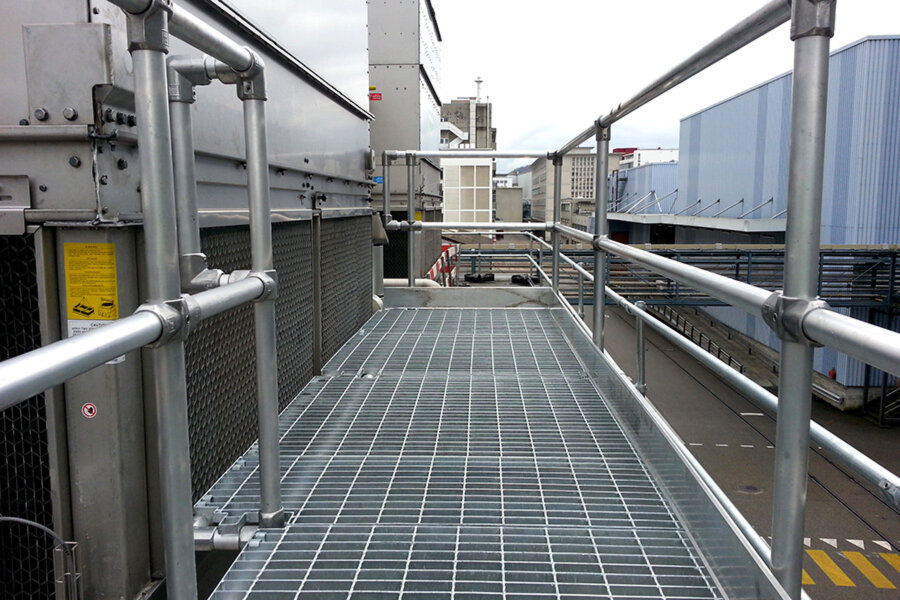
Modular walkway systems have transformed how data centers manage elevated access. Instead of building site-specific structures for each unit, modular platforms can be assembled quickly, adjusted easily, and reused as layouts evolve.
For project managers and facility operators, the advantages are clear:
- Standardized access reduces the need for custom engineering on every project.
- Less disruption during installation or retrofits keeps facilities online.
- Improved worker confidence reduces incidents and turnover, supporting long-term safety culture.
Future-Proofing Data Center Access
As the digital world continues to scale, so will the infrastructure that supports it. Safe elevated access is now a key part of that equation.
By investing in engineered platforms and walkways, data center operators can reduce risk, improve uptime, and ensure compliance from the start. Whether you’re building new or upgrading existing facilities, modular access solutions make it easy to stay ahead of both safety requirements and operational demands.
Simplified Safety can help you design and implement modular data center walkway systems and rooftop platforms built for the next generation of infrastructure.
