Replacing a Rooftop Unit? Here's When the Code Makes You Add Guardrail
Last updated: October 2026.
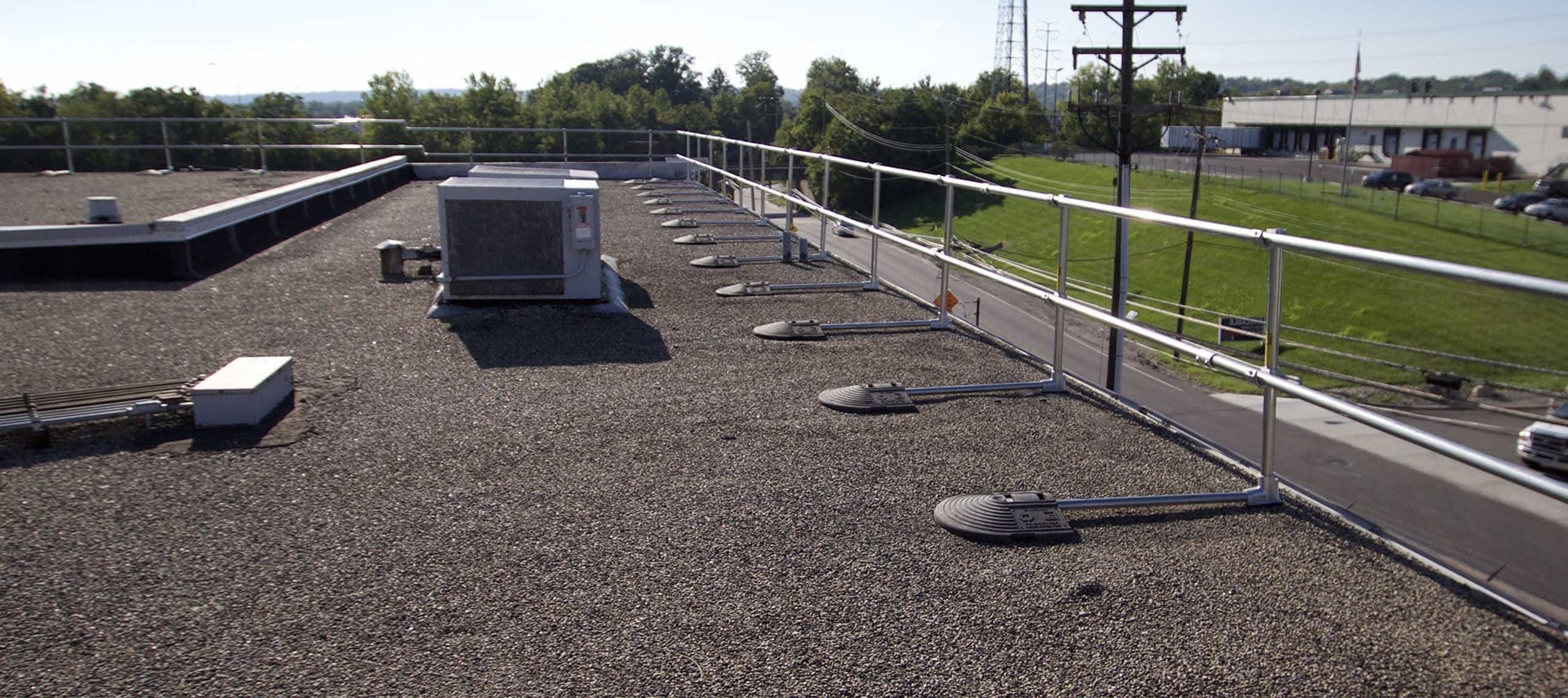
You've got a 20-year-old RTU coming off a curb and a new one going back on the same spot. The unit is 6 feet from the roof edge. Nobody ever put guardrail there. Do you have to add it now?
Maybe. It depends on which code edition your jurisdiction runs, whether they amended it, and how your inspector reads the "existing systems" section. That's not the clean answer anybody wants, but it's the honest one. Here's how to figure out yours before final inspection instead of at it.
The short answer
- The International Mechanical Code (IMC 304.11) and the International Building Code (IBC 1015.6) require guards where equipment that needs service sits within 10 feet of a roof edge with more than a 30-inch drop.
- The guard has to be at least 42 inches tall, run 30 inches past each end of the unit, and block a 21-inch sphere.
- The 2024 IMC lets you skip guards if anchors meeting ANSI/ASSP Z359.1 are installed instead.
- Whether a replacement triggers new guards isn't settled nationally. Some inspectors say yes, some say no, and some jurisdictions wrote their answer into local code.
- A few states, like Oklahoma, go further and add rules for skylights and roof hatches near equipment.
What IMC 304.11 actually says
Here's the 2024 IMC requirement, per the ICC's published text: guards are required where components that need service, and roof hatch openings, are within 10 feet of a roof edge or open side of a walking surface, and that edge is more than 30 inches above the floor, roof or grade below. The guard has to extend at least 30 inches beyond each end of the component, and beyond each end of the roof hatch parallel to the roof edge. It has to stop a 21-inch sphere and meet the IBC's guard loading.
The edition comparison Tucson published for its code adoption shows the 2024 text also spells out that the top of the guard sits at least 42 inches above the surface next to it. And it carries this exception:
Guards are not required where fall arrest/restraint anchorage connector devices that comply with ANSI/ASSP Z359.1 are installed.
Older editions and some local versions word that exception differently. Lubbock, Texas, for example, requires the anchors to be permanent for the life of the roof covering and spaced not more than 10 feet on center along hip and ridge lines and not less than 10 feet from roof edges. Read your local version, not the model code.
The IBC has a matching section, 1015.6, so the same rule shows up even in cities that use the Uniform Mechanical Code instead of the IMC.
Run the numbers on your unit
Say the new RTU is 52 inches wide and sits 6 feet from the edge. There's no parapet.
| Step | Value |
|---|---|
| Unit width | 52 in |
| Extension past the left end | 30 in |
| Extension past the right end | 30 in |
| Minimum guard length | 112 in (9 ft 4 in) |
| Minimum height | 42 in |
| Max opening | Can't pass a 21 in sphere |
That's the code minimum. Think about how the tech gets there. If they come up a ladder 40 feet down the roof and walk along the edge to reach the unit, 9 feet of rail at the unit doesn't protect that walk. We covered this gap in our earlier post, What to Know about Guardrail for Rooftop Mechanical Units. Code minimum and safe aren't always the same length.
Parapets: a parapet only replaces a guard if it's tall enough. Required guards have to be at least 42 inches high. A 30-inch parapet doesn't cut it, but you can add rail on top or behind it.
Does a like-for-like swap trigger new guards?
This is where it gets fuzzy. The IMC's existing systems section (102.4) says additions, alterations, renovations and repairs have to meet the requirements for a new system, without making the whole existing system comply. ICC's commentary adds a carve-out: minor alterations and repairs can be done in the same manner and arrangement as was in the existing system, as long as the work is not hazardous and is approved.
So a new RTU going on an old curb could go either way. Here's what that looks like in the real world:
- "Yes, add guards": plenty of inspectors treat the new unit as new equipment that has to meet current code. That's the situation in our earlier post, where a mechanical contractor finished a swap and got told at final inspection to add guardrail.
- "No guards needed": New Castle County, Delaware issued a staff interpretation that replacing an existing rooftop unit does not require the installation of a guard.
- "No, but post a sign": Lubbock, Texas wrote it into code. Guards aren't required when replacing legally installed equipment in existing rough openings, provided that a fall hazard warning sign is affixed to the service access side of the equipment.
The takeaway: ask before you bid. Call the mechanical plans examiner, describe the swap, and get their answer in writing or in the permit notes. Then price guardrail as a line item or an alternate so it's not a surprise change order at final.
Not sure if your swap needs guardrail? Talk to a real human. Our safety professionals can look at your roof plan and tell you what to price in before you bid.
Some states go further: skylights and roof hatches
You may have heard that the code now requires guards around skylights and roof hatches near equipment, with self-closing gates. That language exists, but it's a state amendment, not the model IMC. Oklahoma's version is the clearest example. Its 2024 IMC change summary splits 304.11 into three triggers:
| Oklahoma trigger | What's required |
|---|---|
| Unit within 10 ft of a roof edge | Guard at the edge, 30 in past each end of the unit |
| Skylight within 10 ft of a unit | Guard extending 30 in past the edge of the skylight. Not needed if the skylight is at least 42 in above the walking surface, or has other fall-through protection |
| Roof hatch within 10 ft of a unit | Guard extending 30 in past the edge of the hatch. If the unit is within 10 ft of the ladder side of the hatch, the guard gets a self-closing, self-latching gate |
| Existing hatch within 10 ft of an edge, plus a new unit on that roof | Add a guard between the existing hatch and the roof edge |
That last row is the one that matters for replacements. In Oklahoma, a new unit anywhere on the roof can trigger a guard at an old hatch near the edge.
Even where your code doesn't say it, OSHA does. Federal rules require skylight protection when people work near them, and California requires it within 6 feet. A skylight screen or roof hatch rail with a self-closing gate is cheap insurance on a job where you're already up there.
Code vs. OSHA: two different jobs
Contractors sometimes mix these up, and it causes problems.
- The building and mechanical code is about the building. It decides what has to be installed to pass inspection and get your permit closed.
- OSHA is about the employer, every time someone goes up there. During installation, your crew falls under construction rules, which require fall protection at unprotected edges 6 feet or more above a lower level. When the service company comes back for maintenance, general industry rules apply, including the low-slope roof zones in 1910.28(b)(13).
Passing inspection doesn't make the roof OSHA compliant for the next tech. That's worth one sentence to the building owner while fall protection is already on the table.
A pre-bid checklist for RTU replacements
- Measure the distance from each unit to the nearest edge, and note parapet heights.
- Check the drop. More than 30 inches below the edge? The 10-foot rule applies.
- Look around the unit. Any skylights or roof hatches within 10 feet? Note which side the hatch ladder is on.
- Pull the local code. Which IMC or UMC edition, and what amendments? Search for 304.11 and any replacement exceptions.
- Call the plans examiner and ask how they treat a like-for-like swap. Get it documented.
- Price guardrail as a line item or alternate, including the access path if it runs along the edge.
- Pick the system: non-penetrating guardrail keeps you from opening up the roof and messing with the membrane warranty. Need a raised work surface too? Look at rooftop HVAC platforms.
- Get submittals showing 42-inch height, 21-inch sphere and IBC guard loading before install.
Want a second set of eyes on a replacement job? Send us the roof plan and unit locations and we'll lay out what the code needs and what makes sense for the techs who come after you. Call 1-866-708-6679 or request a rooftop safety audit. Working in Texas? See our Texas rooftop platform guide.
Replacing an RTU near the roof edge?
Talk to a real human. Our safety professionals can tell you what guardrail the code needs at each unit and what makes sense for the techs who service it later.
Call Our Safety Professionals See KeeGuard Rooftop Guardrail
FAQ
Sources
- ICC: 2024 International Mechanical Code, Section 304.11
- City of Tucson: International Mechanical Code Updates, 2018 to 2024
- ICC: IMC Code and Commentary sample, Section 102.4
- Oklahoma Uniform Building Code Commission: 2024 IMC Code Change Summary
- City of Lubbock, TX: Article 28.11, International Mechanical Code
- New Castle County, DE: Staff Code Interpretation, Rooftop Guards for Mechanical Equipment
This article is general guidance, not legal or engineering advice. Your local building official has the final say. Confirm requirements before bidding.
