Texas Rooftop Maintenance Platform Requirements: What OSHA and Your City Actually Want
Last updated: October 2026.
If you're putting a maintenance platform on a Texas roof, two sets of rules apply. Federal OSHA covers how your people work up there, because Texas doesn't run its own OSHA program. Your city's building and mechanical code covers what has to get built in the first place. Most of the headaches come from the second one, because every city picks its own code edition and writes its own amendments.
Here's what each one requires, with the actual section numbers, so you can walk into a bid meeting or a plan review knowing what you're talking about.
The short answer
| Requirement | What it says | Where it comes from |
|---|---|---|
| Guardrail on platform edges | Any platform or walking surface 4 feet or more above a lower level needs guardrail, a safety net, or personal fall protection | OSHA 1910.28(b)(1) |
| Guardrail height and strength | Top rail at 42 inches, plus or minus 3. Holds 200 lbs down or out without dropping below 39 inches. Midrail holds 150 lbs | OSHA 1910.29(b) |
| Stairs up to the platform | Standard stairs at 30 to 50 degrees. Ship stairs (50 to 70 degrees) only when standard stairs aren't feasible | OSHA 1910.25 |
| Fixed ladders over 24 feet | New ladders since Nov. 19, 2018 need a ladder safety system or personal fall arrest. All fixed ladders by Nov. 18, 2036 | OSHA 1910.28(b)(9) |
| Equipment near a roof edge | A unit that needs service within 10 feet of an edge with more than a 30-inch drop gets a 42-inch guard that runs 30 inches past each end | IMC 304.11 / IBC 1015.6 |
| Permanent roof access | If the climb to reach equipment is more than 16 feet, you need permanent access, not a portable ladder | IMC 306.5 |
Now the details, because the details are where people get burned.
Who enforces what in Texas
OSHA's own state plan page puts it plainly: Texas is not an OSHA-approved state plan, so federal OSHA covers most private sector workers, and state and local government workers are not covered by federal OSHA. That means:
- Private companies (warehouses, plants, retail, data centers, property managers) follow 29 CFR 1910 for maintenance work and 29 CFR 1926 for construction work.
- Cities, counties and school districts can't get an OSHA citation. The roof is just as tall, though, and the lawsuit after a fall doesn't care who your regulator is. Most public owners we work with spec to OSHA anyway.
Building codes are a different story. State law sets the International Building Code as it existed on May 1, 2012 as the municipal commercial building code, and lets cities adopt local amendments and newer editions. The Legislature keeps looking at bumping that baseline up, so check the current statute. In practice, the big cities are running much newer codes than 2012, and they don't all run the same mechanical code. More on that below.
There's no special OSHA "maintenance platform" standard
People search for "OSHA maintenance platform requirements" expecting a dedicated rule. There isn't one. To OSHA, a rooftop platform is a walking-working surface, so it falls under the same general industry rules as a mezzanine or a catwalk. That covers all the usual rooftop setups:
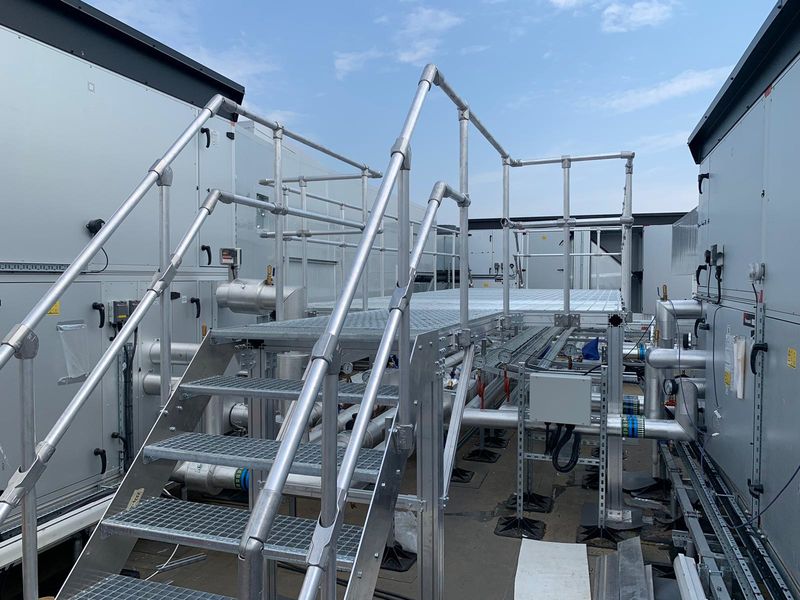
- A raised platform so a tech can reach the service panels on a tall RTU or air handler
- A crossover that gets people over ductwork, pipe racks or a roof level change
- A level work surface next to equipment on a pitched roof
- Walkways and stair towers around chillers and cooling towers
If you want the full federal breakdown, we cover it in OSHA platform requirements. Below is what matters most on a roof.
Guardrail specs for rooftop platforms
Under OSHA 1910.29(b), guardrail on a platform has to meet these numbers:
- Top rail height: 42 inches, plus or minus 3 inches, measured from the platform surface.
- Strength: 200 lbs applied down or out within 2 inches of the top edge, anywhere along the rail. Under that load, the top rail can't sag below 39 inches.
- Midrail: about halfway up, good for 150 lbs. Screens or balusters work instead if the openings stay at 19 inches or less.
- Toeboards: wherever a dropped wrench could land on somebody below, per 1910.29(k).
- Stair rails: for systems installed on or after Jan. 17, 2017, at least 42 inches from the leading edge of the tread.
The building code adds its own wrinkle. Guards at mechanical equipment can't let a 21-inch sphere pass through, and they have to meet the IBC's loading rules. A system that meets both OSHA and IBC is the one you want, since you'll be answering to both.
Stairs, ship stairs or a ladder?
OSHA sorts these by angle. Pick the wrong one and you're out of compliance before anybody even climbs it.
| Type | Angle from horizontal | When you can use it |
|---|---|---|
| Ramp | 30 degrees or less | Anytime |
| Standard stairs | 30 to 50 degrees | Default choice |
| Ship stairs | 50 to 70 degrees | Only when standard stairs aren't feasible |
| Alternating tread stairs | 50 to 70 degrees | Only when standard stairs aren't feasible |
| Ladder | 60 to 90 degrees | Per 1910.23 |
That "not feasible" part matters. Per 1910.25, spiral, ship or alternating tread stairs are only allowed when the employer can show standard stairs won't work. "Ship stairs were cheaper" isn't that.
For fixed ladders, OSHA's own FAQ spells out the timeline: personal fall arrest or ladder safety systems on new fixed ladders since Nov. 19, 2018, and all fixed ladders equipped by November 18, 2036. If you're putting in a new ladder to a rooftop platform today, plan for the ladder safety system now. Cages don't count anymore for new ladders over 24 feet.
Don't forget the walk to the platform
A compliant platform doesn't help if your tech crosses an unprotected edge to get to it. OSHA's low-slope roof rule, 1910.28(b)(13), splits a flat roof into zones:
| Distance from roof edge | What OSHA requires (general industry) |
|---|---|
| Less than 6 feet | Guardrail, safety net, travel restraint or personal fall arrest. No exceptions. |
| 6 feet to less than 15 feet | Same options, or a designated area (warning line) if the work is both infrequent and temporary |
| 15 feet or more | Fall protection or a designated area. If the work is infrequent and temporary, a strictly enforced work rule can do the job |
"Infrequent" has a real meaning. Per OSHA's preamble, as summarized in this state fact sheet, tasks done on a daily, routine or regular basis are not infrequent. Monthly filter changes on a big-box roof are routine, and an OSHA citation for an unprotected roof edge is a common result of treating them otherwise. If the path from the hatch or ladder to the platform runs within 6 feet of an edge, that path needs guardrail or a walkway with rails, every trip.
The building code layer: Texas city by city
This is where Texas gets interesting. The big cities don't all use the same mechanical code, and the rooftop guard rules live in the mechanical code.
| City | Mechanical code | Worth knowing |
|---|---|---|
| Houston | Uniform Mechanical Code (UMC), not the IMC | Section numbers differ from the IMC. The IBC guard rules still apply through the building code. Ask your plans examiner how they handle rooftop equipment guards. |
| Austin | 2024 UMC | Moved to the 2024 codes, including the 2024 IBC, effective Jan. 1, 2025. |
| San Antonio | 2024 IMC | City Council adopted the 2024 ICC codes on Jan. 30, 2025. |
| Fort Worth | 2021 IMC, amended | Building code is the 2021 IBC with local amendments. |
| Lubbock | 2021 IMC, amended | Exempts like-for-like RTU replacements in existing rough openings from new guards, if a fall hazard warning sign goes on the service side. Requires a 30-inch level platform with guards for equipment on roofs sloped 6:12 or steeper. |
Dallas, El Paso, Arlington and everybody else: pull your city's adopted code list and its amendments before you bid. Codes get updated every few years, and amendments like Lubbock's can change your scope.
Not sure which code your city runs or where guards are required on your roof? Our team can walk the roof with you and spec it out.
The 10-foot rule with real numbers
Under IMC 304.11, guards are required where components that need service, or roof hatch openings, sit within 10 feet of a roof edge and that edge has more than a 30-inch drop. The guard has to run at least 30 inches past each end of the unit.
Say you've got a 48-inch-wide RTU sitting 7 feet from the edge:
- Unit width: 48 inches
- Plus 30 inches on each side: 60 inches
- Minimum guard length: 108 inches, or 9 feet
- Height: at least 42 inches. Openings: no 21-inch sphere gets through.
Two things trip people up here:
- A parapet only counts if it's tall enough. Required guards have to be at least 42 inches high under IBC 1015.3. A 30-inch parapet doesn't get you there. You can add rail on top of it.
- The anchor exception isn't free. The 2024 IMC says guards aren't required where fall arrest or restraint anchorage connectors meeting ANSI/ASSP Z359.1 are installed. That's legal, but now every tech on that roof needs a harness, training, a rescue plan and a habit of actually clipping in. Guardrail protects everybody with zero training.
For the full rundown on roof edge guardrail beyond equipment platforms, see Rooftop Guardrail Requirements: OSHA (U.S.) and CSA (Canada).
Texas conditions that matter for rooftop platforms
- Heat. Steel decking and rails in July sun get hot enough to burn bare hands. Spec grip surfaces your techs can actually hold, and think about galvanized or aluminum that won't rust out from humidity on the coast.
- Wind. Coastal and Panhandle sites see serious wind loads. If you're using non-penetrating (ballasted) platforms or railing, get the manufacturer's engineering for your site's design wind speed under whatever IBC edition your city uses. Don't eyeball ballast.
- Huge flat roofs. Distribution centers and big-box stores mean long walks from the hatch to the equipment. Mark a path, protect it where it gets near the edge, and use walkway pads so you're not chewing up the membrane.
- Roof warranties. Penetrating the roof to anchor a platform can void a membrane warranty. Non-penetrating systems avoid that, but see the wind note above.
Checklist before you buy or build a rooftop platform in Texas
- Is the client private or public? That decides if OSHA can cite them. Spec to OSHA either way.
- Which city, and which code editions? Pull the adopted IBC and mechanical code (IMC or UMC) plus local amendments.
- Measure every unit that needs service: how far is it from the nearest edge, and how tall is the parapet?
- How high is the climb to the roof? Over 16 feet means permanent access under IMC 306.5.
- Map the walk from the access point to each platform. Anything within 6 feet of an edge needs protection.
- How often does someone go up there? Routine work rules out the "infrequent and temporary" shortcuts.
- Penetrating or non-penetrating? Check the roof warranty and get wind calcs for ballasted systems.
- Get submittals that show OSHA 1910.29 and IBC guard loading compliance before anything ships.
If you'd rather have someone else sort this out, our team does rooftop safety audits and designs rooftop HVAC platforms and stairs and crossovers for Texas sites. Call 1-866-708-6679 or send us your roof plan.
Need a rooftop platform for a Texas site?
Send us your roof plan or a few photos. We'll tell you what OSHA and your city's code require and design a platform, stairs or crossover that meets both.
FAQ
Sources
- OSHA: State Plans
- OSHA 29 CFR 1910.25, Stairways
- OSHA 29 CFR 1910.29, Fall protection systems criteria (text)
- OSHA FAQs on 1910 Subparts D and I
- ICC: 2024 International Mechanical Code 304.11
- Texas Local Government Code 214.216
- City of San Antonio: Codes and Ordinances
- City of Austin: 2024 Technical Codes
- City of Lubbock: Article 28.11, International Mechanical Code
- City of Fort Worth: Mechanical Code
This article is general guidance, not legal or engineering advice. Codes and adoptions change. Confirm requirements with your local building official and a qualified professional.
