Guardrails for High Velocity Hurricane Zones in Florida

Have you ever stepped onto a roof, been hit by a blast of wind, and realized that your life was at risk?
We recently helped one of our customers with this very problem. They needed a certificate of occupancy, but the inspector could not complete the inspection because they were concerned about one of their roofs.
Our customer is in Southeast Florida, which probably tells you all you need to know about why the inspector had high speed wind concerns.
Our customer did have anchors for window washing, but the inspector did not feel safe stepping onto the roof without a guardrail also being installed.
We learned a lot about wind loads for guardrails while helping our customer. Now, we want to help you, through our experience, to navigate similar obstacles.
In this article, we’ll explore the following topics:
- What codes apply
- How wind affects your guardrail
- What questions you need to answer
- What guardrail we used to solve our customer’s problem
Know the Guardrail Codes that Apply to High Velocity Zones
The first thing you need to do is figure out what codes apply. The various codes will have different requirements. Sometimes, multiple codes will have different ways to handle the same problem. Whatever the difference, the strictest code will apply.
Here are the codes that we needed to be mindful for my customer in West Palm Beach, FL.
- Florida Building Code (FBC): The FBC applies any time a permit is required, or an inspector will be on site. The focus is on building, renovating, or repairing structures in Florida.
- Miami Dade County Code of Ordinances: Even though West Palm Beach is not Miami Dade, we wanted to be mindful of the stricter code requirements here because Miami Dade is a High Velocity Hurricane Zone (HVHC) and West Palm Beach is nearby. You may be required by an architect or other related authority to follow Miami Dade requirements.
- OSHA: This is a federal organization in charge of regulating workplace health and safety. Information about guardrails would be found under 1910.28 and 1910.29.
The difficult part of this is wading through these different codes to find out which parts apply to your situation. It can be very daunting. However, I am going to break down the need-to-know parts for you here to give a basic understanding of what’s needed. If you’re already familiar, then you can skip this part.
Florida Building Code and OSHA Guardrail Basics
Below you will find the basic requirements for guardrails in Florida according to the building code and OSHA. If you want a more in-depth review of guardrail codes for OSHA, then check out our OSHA guardrail guide.
FBC complies with OSHA guardrail requirements below, with a few additions.
- 42 inches in height (+/- 3 inches in OSHA)
- Have a midrail so a sphere of 19 inches cannot pass between the top rail and the walking surface
- The top needs to withstand a 200-pound concentrated load
- Fall protection is needed anytime there is a drop of 4 feet or more.
- Guardrails may need to withstand 50 pounds of force per linear foot.
- You may need infill panels or other designs to prevent a sphere of 4 inches from passing anywhere between the top rail and the walking surface.
- A guardrail is needed when there is a level change of 30 inches or more.
There are exceptions and modifications that may be required based on your situation, but these are the general requirements. If you have more questions, contact our experts and we’ll help you sort through what codes apply and how to apply them.
Wind Load Guardrail Requirements in Florida

There is a lot to unpack when it comes to wind load requirements for guardrails in Florida, or anywhere else, really. However, I’ll give you a simple solution. You need an engineer qualified in your state with experience working with fall protection and wind load calculations. That’s what we provided for our customer.
In Chapter 16 Section 1609, FBC says, “Wind loads on every building or structure shall be determined in accordance with Chapters 26 to 30 of ASCE 7”. ASCE is the American Society of Civil Engineers, which, among other things, is an authoritative source for codes and standards that protect the public.
What all this means to you is that your engineer should know the details of how your guardrail should be designed to be safe and compliant in high wind zones.
If you don’t have an engineer for your guardrail, then don’t fret. As I said, we provided one for our customer and we can do the same for you. All you have to do is contact our experts and they will use our engineer to get you everything you need for a rooftop guardrail.
What Rooftop Guardrails can be used in High Winds?

Any guardrail can work if an engineer can prove that it complies with building code. Make sure to get an engineer’s stamp of approval with the wind calculations specific to your address.
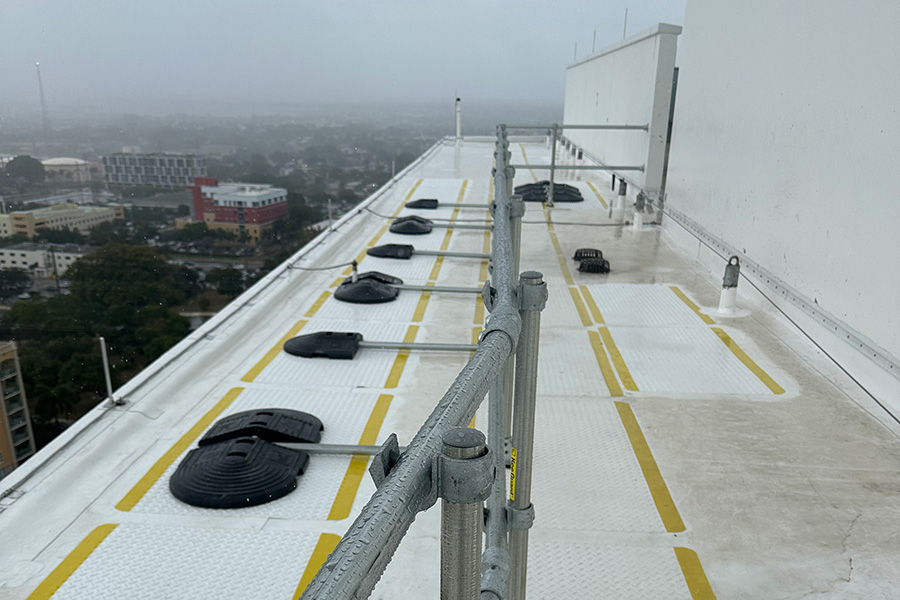
Kee Guard rooftop guardrail has been consistently designed to comply with high wind speeds and installed in Florida. This is the guardrail that we provided for our customer.
What about non-penetrating guardrails in high winds?
A non-penetrating guardrail, like Kee Guard, can be used in high wind environments if the engineering shows that it can work. The guardrail may need additional weight and it may need to be mounted to a structure on each end. After all, two attachment points are much better than two hundred.
This means that you should NOT just buy some construction guardrail and slap it on your roof, calling it a day. A flying guardrail removes safety from the roof and is a potential catastrophe for anyone below that roof when the guardrail goes flying.
Common Questions to Design a High Wind Compliant Guardrail

There is a lot that goes into designing a compliant guardrail system. That’s even more true when you’re dealing with high winds.
I spoke with an engineer and here are a few questions that you need to answer to help an engineer design a safe guardrail.
What is the address of your building?
The specific address of your building will give an engineer a lot of information. The ASCE has a wonderful tool called the ASCE Hazard Tool. This tool tells an engineer about the various hazards, like wind loads and seismic concerns, and the levels of those hazards.
This will give the engineer a starting point to know what the guardrail needs to withstand.
For instance, if the engineer just plugged in Miami, FL into the tool, then the base wind speed to consider is 169 mph. I don’t think your standard safety yellow construction guardrail is going to be able to handle that.
How tall is the roof in question?
The taller the building, the more wind exposure on the roof. Also, knowing the height of your building compared to any natural or man-made structures in the vicinity will impact the flow of wind.
What roofing material is used on the roof?
This is all about friction. If you have any hope of protecting your roof from holes, then friction will be key when using a non-penetrating guardrail.
An asphalt roof and TPO roof are very different. TPO roofs are white PVC roofs that are very slippery when wet or frozen. Even in the best of conditions, like sunny with a subtle breeze, rain from the day before can make a TPO roof an ice rink. Just imagine what high winds can do on a roof like that.
Is there a parapet and how tall is it?
A parapet on your roof can do a few things. Parapets are potential attachment points for guardrails, even non-penetrating ones. Sometimes a non-penetrating guardrail needs to be secured on each end to be compliant. Remember, a couple of attachments are better than many.
A parapet can affect the tipping point of a guardrail. The way a guardrail buts up against a parapet, especially a short one, can cause a pivot that needs to be accounted for. Taller parapets may be a good buttress for a non-penetrating guardrail. However, wind will still be a factor and needs to be considered.
Where is the guardrail going to be placed?
Where the guardrail is placed on the roof will determine how much force the wind will apply to it. Corners and roof edges are going to experience a greater wind load than guardrails placed 15 feet from the roof edge.
How does this work? Well, the engineer said I would need to take courses on fluid dynamics and wind flow to understand it. However, the helpful and very simplified analogy he gave me was imagining my thumb on a house as water is flowing out of it. The water is the wind, and our thumb is the building.
What is the guardrail length and layout?
The length and layout of the guardrail will affect how the wind interacts with it. Short runs have less space for the wind to hit, but less strength to withstand that wind. Smaller is not better when it comes to defending against high winds, especially with non-penetrating guardrails.
Guardrails with corners or full perimeter will add additional weight and support when withstanding high winds.
What other requirements does your guardrail need to comply with?
Other details that are important are load requirements and infill panel requirements for guardrails. 50 pounds per linear foot for building code compliance may mean that posts are closer together. More posts mean more weight, good, and more surface area for the wind to hit, not so good.
Speaking of surface area, if you need to comply with the 4-inch sphere rule for building code, that’s a lot more surface area that needs to be accounted for.
These questions are just a part of what an engineer needs to consider when designing an appropriate guardrail. We haven’t even talked about uplift or the difference between wind speed and wind pressure. It is vital that you work with a company that understands these requirements when choosing a guardrail for high wind rooftops.
What are Your Next Steps?
If you’re in a high wind zone or just are concerned about wind speeds on your rooftop, then contact our experts. We will talk through your concerns and get details on your situation to provide the guardrail that you need to keep people safe from fall hazards without ignoring wind hazards.
I want to thank you both for your involvement in the roof railing solution at the **** project. We are installed and it passed inspection this afternoon.
The effort and approach you all took to this issue was everything we could have asked for.