Installing Permanent Parapet Railings Just Got Easier
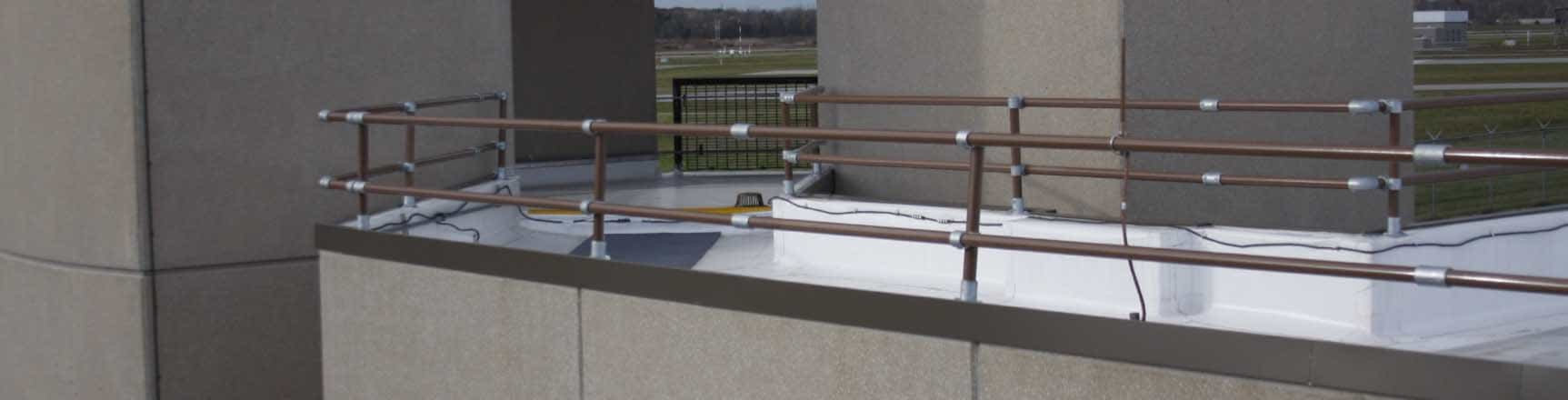
Here's a mistake we see all the time. A building has a parapet wall running around the roof, that low wall at the edge, and everybody assumes it counts as fall protection. It's a wall, it's at the edge, so you're covered, right? Not usually. Most parapets were built for looks, for drainage, or to hide the rooftop equipment from the street, not to stop a person from going over. And a wall that's too short or too weak to do the job is worse than no wall at all, because it gives your crew a false sense of safety.
So let's answer the question people actually ask: how high does a roof parapet need to be, and what do you do when yours comes up short. It's a common problem with a straightforward fix, and it's worth understanding before an inspector or an incident forces the issue.
How high does a parapet need to be?
A parapet has to be at least 39 inches tall to count as fall protection, and here's where that number comes from. OSHA requires a guardrail to have a top edge 42 inches above the walking surface, give or take 3 inches. That tolerance means anything from 39 to 45 inches can qualify on height. So the floor is 39 inches. A parapet shorter than that does not meet the requirement, full stop.
The trouble is, most parapets don't get there. A lot of them are built in the 18 to 24 inch range, tall enough to trip over, nowhere near tall enough to stop a fall. That's closer to a curb than a barrier. A worker can lean over it, trip over it, or get bumped over it a lot easier than people assume. If your parapet is in that range, it's not protecting anybody, no matter how solid it looks.
Height alone isn't enough (the part people miss)
Even if your parapet clears 39 inches, you're not automatically done. A parapet has to pass a three-part test before you can treat it as a guardrail:
- Tall enough. At least 39 inches, per the rule above.
- Strong enough. OSHA says a guardrail has to withstand 200 pounds of force applied to the top. A lot of older parapets, especially masonry ones that have weathered, can't be trusted to take that kind of lateral hit. If your parapet can't hold 200 pounds, it doesn't qualify, even at the right height.
- Continuous enough. The protection has to actually cover where people are exposed. This one surprises people, because plenty of buildings have a parapet on one or two sides and nothing on the others, or a newer addition where the parapet just stops. A gap in the wall is a gap in your protection.
One more detail worth knowing, because it catches people: if your parapet is shorter than 21 inches, OSHA treats the gap above it as needing a midrail as well, not just a top rail. So a very short parapet doesn't just need height added, it needs a proper railing system that fills the opening.
What to do when your parapet comes up short
The good news is you don't have to tear anything out or rebuild the wall. The common fix is a parapet-mounted railing that attaches to the existing wall and raises the effective height up to the compliant 42 inches. Prefabricated railing sections slide into receiving posts that clamp or fasten to the parapet, and you're compliant without masonry work.
There's a smart design detail here that a lot of people don't know about. The railing can be built to angle back and away from the roof edge instead of straight up. Angling it inward does two things: it adds strength, and it keeps the railing less visible from the ground, which preserves how the building looks from the street. That matters more than you'd think on buildings where an architect or a co-op board cares about the roofline. You get the protection without the roof sprouting an obvious fence.
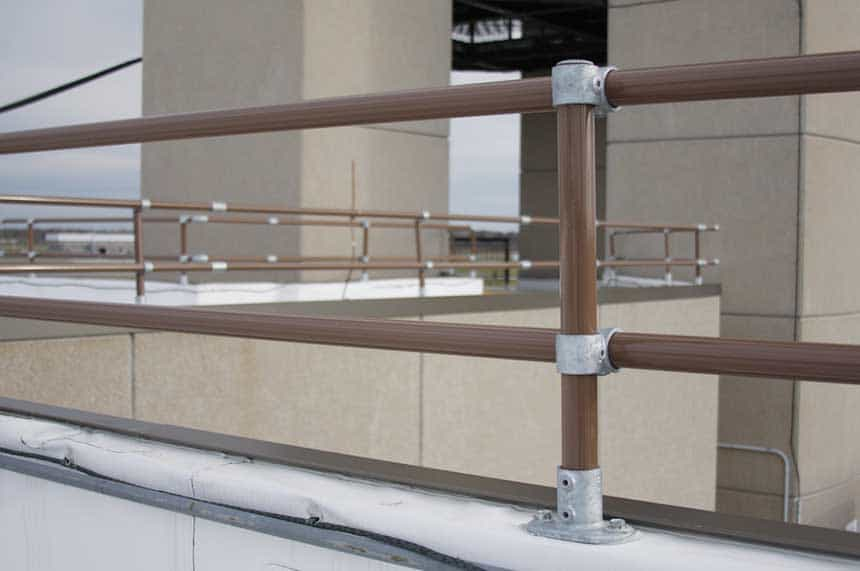
A few things make parapet railing a good fit:
- It uses the existing parapet instead of fighting it, so it's usually less material and less work than a freestanding system.
- It's permanent and passive. Once it's up, everybody on the roof is protected with no gear to wear and no training to keep up.
- It can be galvanized or powder-coated to hold up outdoors and match the building.
- It can be used permanently or as a longer-term temporary solution, depending on what the building needs.

Parapet railing does need to fasten to the parapet, so it's the right call when penetrating the parapet wall is acceptable. If you can't penetrate the parapet, or there's no parapet to work with at all, that's when a KeeGuard non-penetrating roof railing is the better route, since it sits on the roof surface and holds itself down with weighted bases instead of attaching to anything.
How to figure out what your building needs
Start by walking your roof with a tape measure. Check the parapet height on every side, not just one, because they often vary, and look for the spots where the parapet drops off, changes height, or disappears at an addition. Those gaps are usually where the real exposure is.
From there, it's worth getting a set of eyes on it that does this for a living. We offer a free rooftop audit, so you can send us your parapet measurements and a few photos and we'll take a look and tell you exactly what it takes to bring the roof up to compliance, whether that's parapet railing, a non-penetrating system, or a mix on a roof where the parapet only covers part of the perimeter.
Frequently asked questions
Sources
- OSHA 29 CFR 1910.29, Fall Protection Systems Criteria (general industry, 42 in / 200 lb / midrail)
- OSHA 29 CFR 1926.502, Fall Protection Systems Criteria (construction)
- Roof Parapet Railing, Simplified Safety
Related reading: Can a Parapet Wall Be Fall Protection? and 5 Things to Consider When Buying Guardrail.
Not sure if your parapet makes the grade?
Send us your parapet measurements and a few photos. Our rooftop audit is free, and we'll tell you exactly what it takes to bring your roof up to compliance, with no obligation.
![Rooftop Parapet Railing for Rochester ATCT [Case Study]](https://sbc-content.s3.amazonaws.com/catalog/product/cache/1/image/440x286/040ec09b1e35df139433887a97daa66f/6/4/6422617643_eaf659662c_z.jpg)


