Manufacturing Plant and Warehouse Fall Protection
Picture this, you’ve just taken on the job as Safety Manager for your company. You’re excited to get started in your new role and bring a new level of safety compliance to your facility.
However, on your first day on the job, you realize just how unsafe your warehouse is.
What do you do? Do you abandon ship? Do you brush it off and say, “I’ll get to it later”? Or do you take on the responsibility and get to work right away?
This was the case for one of our customers who needed to implement fall protection throughout their facility.
In this article, we’ll discuss what prompted our customer to incorporate fall protection and safe access points in their warehouse, and how we were able to design and help install their system on site.
Understanding Warehouse OSHA Compliance
Our customer has a large manufacturing and warehouse facility where they manufacture timing belts as well as shipping and receiving from their building.
This where we begin our story. Our customer, per their request we will keep it anonymous so let’s call him Steve, had just become the safety manager at his company. Day one rolls around, and he takes an OSHA 30 course, which provides an in-depth and industry specific training for supervisors and with safety and health responsibilities.
Steve quickly realizes when taking this course that their plant is not compliant and he needs to get to work fast to make it not just compliant, but to protect his workers and ensure the work they’re doing is safe.
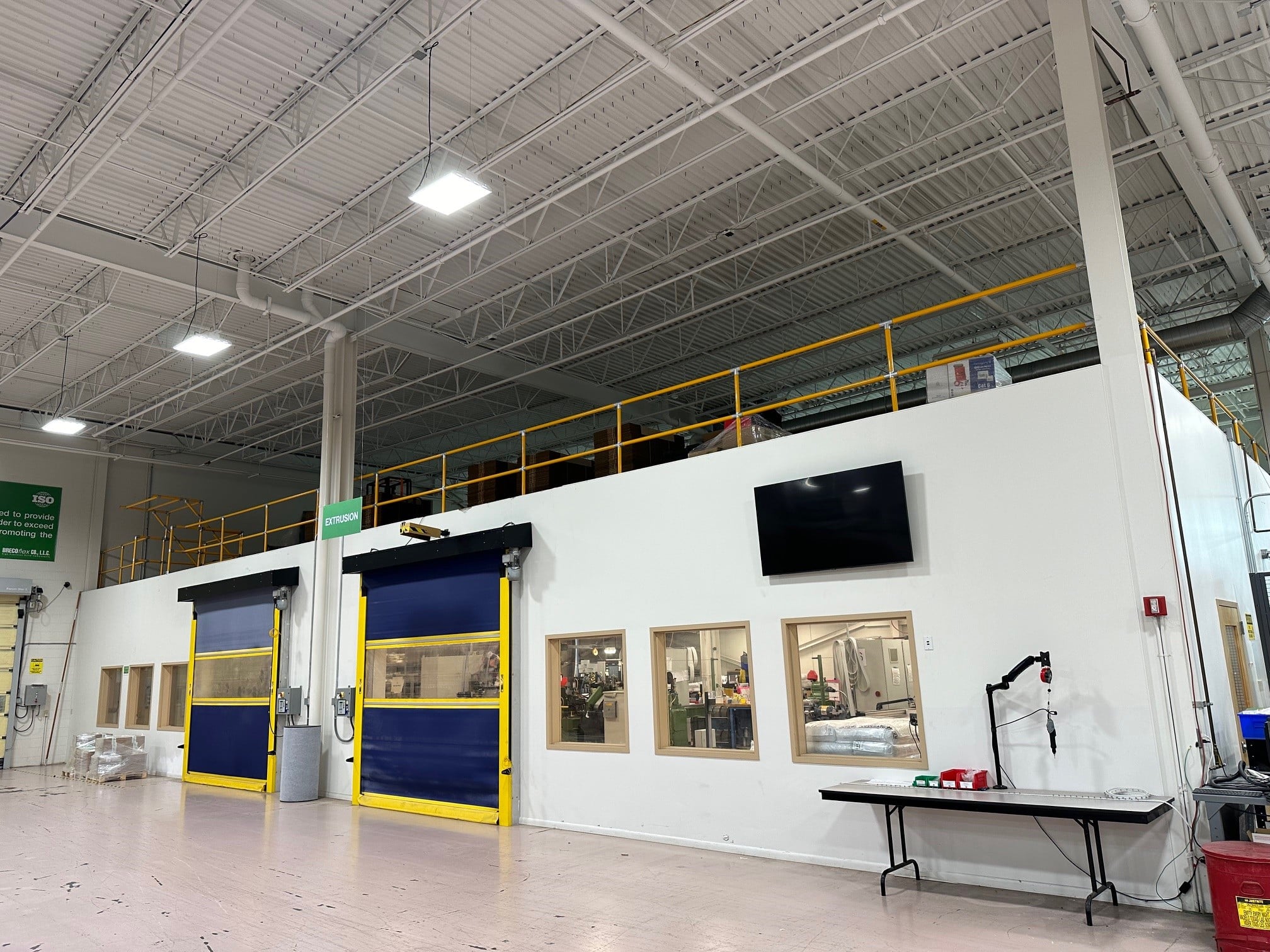
He focuses on one main area within his manufacturing building, the mezzanine. Now on this mezzanine, it’s an additional place where they store pallets of products so that they don’t clutter the floor.
Now that’s all well and good until you understand that people are walking and working on top of this mezzanine with dangerous fall hazards around.
General Industry OSHA Standards

OSHA 1910.28(b)(1)(i) states: “Except as provided elsewhere in this section, the employer must ensure that each employee on a walking-working surface with an unprotected side or edge that is 4 feet (1.2 m) or more above a lower level is protected from falling..”
So, when Steve’s workers were on the mezzanine either accessing or moving product on top of this mezzanine, they were exposed to a fall and needed to be protected.
OSHA Safe Access Points

Next, when people would be gaining access to the mezzanine they were using this stair system.
While this type of stair is compliant with reaching higher shelves on the warehouse floor or as a temporary solution. It is not a permanent and compliant system for accessing a higher level.
According to OSHA code 1910.25, stairs must be equipped with a self-closing safety gate and have guardrail along the sides of the upper level that expose a user to a fall.
Both the mezzanine edge and the stairs leading up to the mezzanine were the first areas Steve wanted to tackle on his quest to make his company safe and OSHA compliant.
Connecting with Fall Protection Experts
Steve began search for solutions as anyone does this day-and-age, Googling it.
This is where Steve came across us here at Simplified Safety. After scrolling through our website to determine if we had the right product for him, Steve contacted us and got connected with one of our fall protection experts, Katie.
Katie and Steve began to discuss the details of this project and focused in on all the problem areas we mentioned before. This all seems like a tall task to get working on right away, but we were up for the challenge.
Designing Mezzanine Guardrail and Pallet Gates
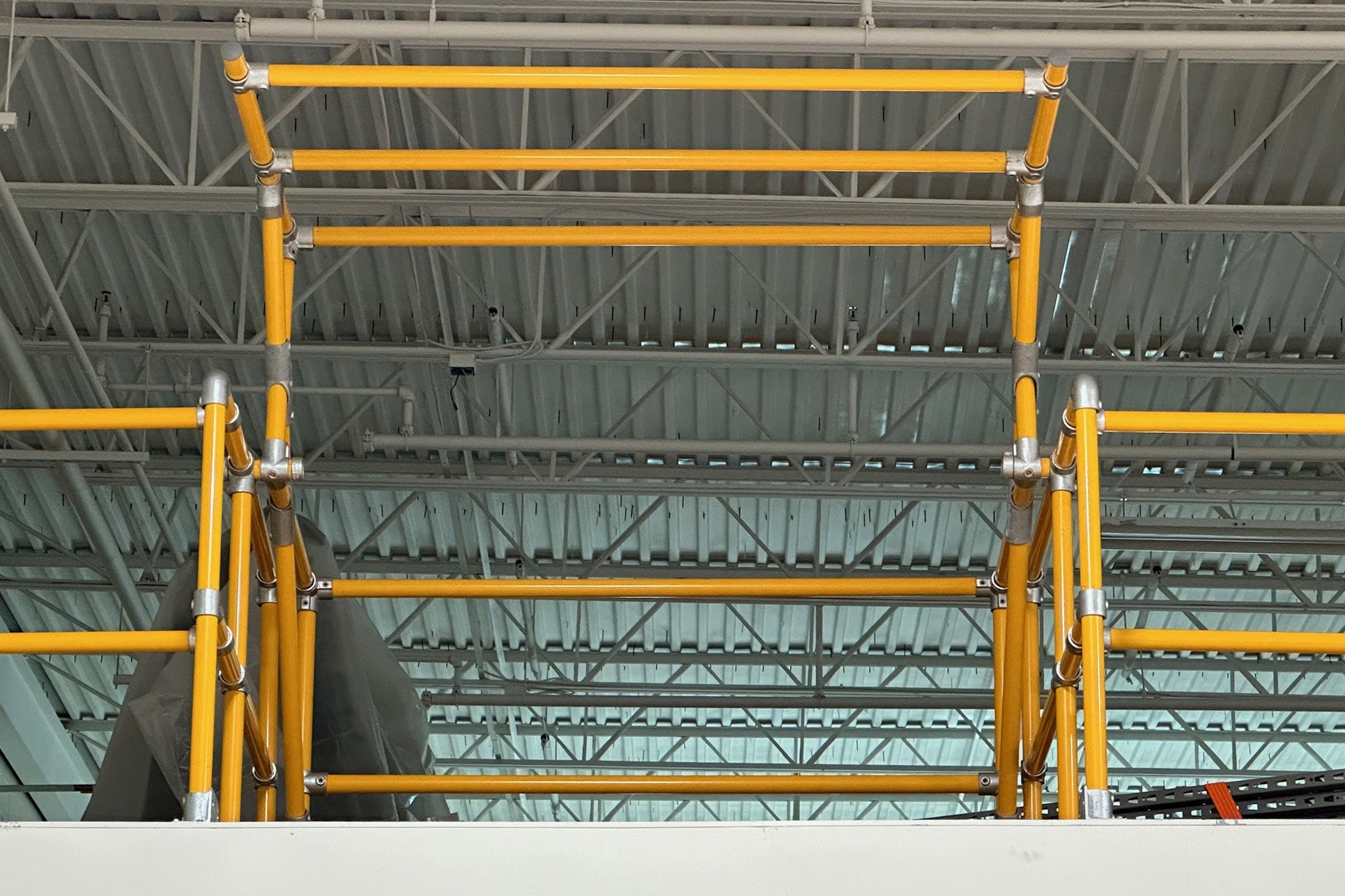
As mentioned, our customer moves pallets of product up to their mezzanine for storage. So, how do they continue to do that while still incorporating fall protection to the mezzanine?
This is where our mezzanine pallet gates come into play. With these pallet gates, you can safely lift pallets up to and off mezzanines without sacrificing fall protection.
Katie was able to show this to Steve who was elated to see the easy functionality of the gate and continued protection from fall hazards without inhibiting their work flow.
Safe Access Points in Warehouses

Now, they needed to safely get up to the mezzanine. Now there are two main ways to get to the upper level. That being ladders or stairs, and seeing as how they already were using stairs and ladders can be cumbersome, as well as coming with their own host of fall hazards concerns, Katie designed a safe and durable stair system for Steve and his team.

With this stair system, it will safely protect the worker going up and down the stairs, along with a self-closing safety gate at the top and bottom of the stairs to continually protect users.
As we mentioned, at the top of the stairs when you access the upper level, you need guardrail that extends in any direction where the user can be exposed to a fall hazard. This guardrail seamlessly fits in with the stair system and the pallet gate to ensure continuous protection along the entirety of the mezzanine.
Installing Warehouse Fall Protection

Now that the plans and designs were made, it was time to visit the site to see the site firsthand and walk through it with one of our installers. This visit gave peace of mind and confidence to our customer that the system was right for their project and that it would all be installed correctly.
I mentioned our installer did this, and while we do offer our own installation, our pre-engineered systems are designed so that any team can install it on their own.
Our products and solutions are designed with pipe and fittings systems. There’s no welding (unless you are doing certain fabricated systems) and interlock using a set screw system that can be easily assembled with hex keys.
So, if you have a solid maintenance team or a local installer, you can have your system ordered and delivered to your location and then have your team install it with ease.
Post Fall Protection Installation

Once everything was installed and in place, Steve could not have been more excited. From start to finish Steve was pleased by the work Katie put in and the finished product our installers assembled.
Steve had this to say.
“I appreciated that you were able to re-quote and work the project out to fit into our budget. That was refreshing since most vendors I work with just say, “here is our price, deal with it”. Also, I was relieved to find out that you could provide pre-engineered solutions, so we didn’t have to create something from scratch. The president of our company is also very satisfied with the project.”
Katie continues to work with Steve on the second phase of their safety program to install rooftop railing in spring of next year, so we look forward to working with Steve and his company in the future!
If you have any questions about fall protection for your manufacturing plant or warehouse, please contact our experts today to get started on making your facility safe and OSHA compliant.
