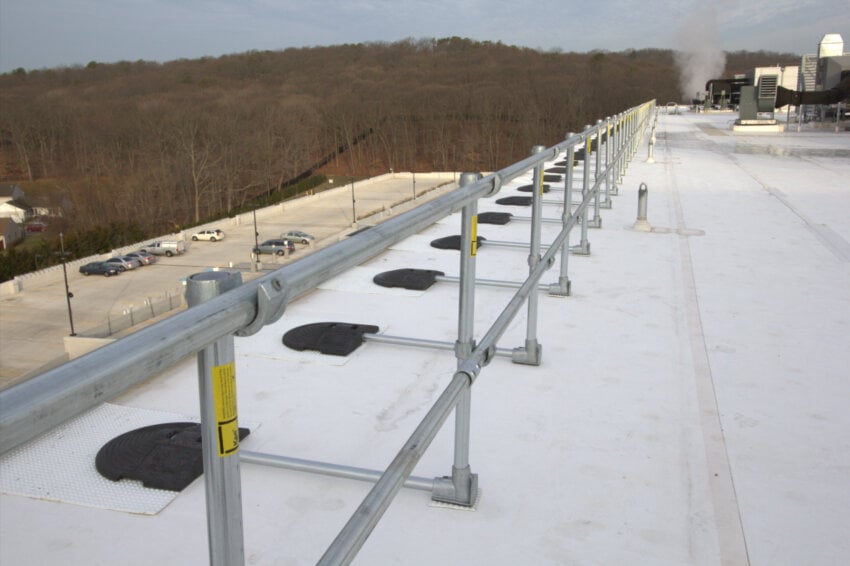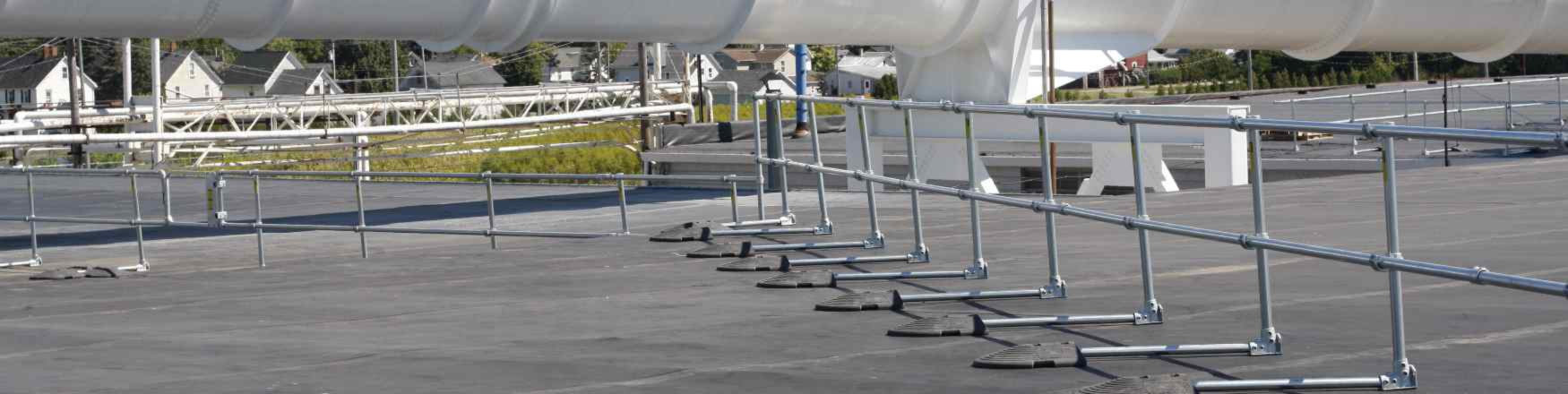
OSHA Guardrail Requirements
Identifying your fall hazards is just one part of ensuring a safe work environment, it's also important to understand OSHA railing requirements to ensure your facility is compliant. Designing an OSHA compliant railing system is equally important; post-spacing, material choice, finish, toeboard, and gates are all things to consider when designing your guardrail.
Simplified Safety has helped thousands of facilities design and install OSHA-compliant guardrail and handrail systems. This guide breaks down OSHA’s rules for guardrails and handrails, clears up the most commonly misunderstood requirements, and explains what those standards really mean in practical, real-world terms.
All OSHA Requirements at a Glance
- Guardrail height: 42” ± 3”
- Handrail height: 30–38”
- Midrail spacing: halfway between top rail and surface (~21”)
- Load capacity: must withstand 200 lbs of force outward or downward
- Toe boards: minimum height of 3.5”
- Materials: smooth, durable, corrosion-resistant metal or GRP
- OSHA references: 29 CFR 1910.29(b) & 1910.29(f)
When Does OSHA Require Guardrail?
The following is an excerpt from OSHA 1910.28 (b) that covers the responsibility for fall protection on working and walking surfaces. Please review the full code for further information.
1910.28(b)(1)
Unprotected sides and edges.
1910.28(b)(1)(i)
Except as provided elsewhere in this section, the employer must ensure that each employee on a walking-working surface with an unprotected side or edge that is 4 feet (1.2 m) or more above a lower level is protected from falling by one or more of the following:
1910.28(b)(1)(i)(A)
Guardrail systems;
1910.28(b)(1)(i)(B)
Safety net systems; or
1910.28(b)(1)(i)(C)
Personal fall protection systems, such as personal fall arrest, travel restraint, or positioning systems.
1910.28(b)(3)(i)
Each employee is protected from falling through any hole (including skylights) that is 4 feet (1.2 m) or more above a lower level
1910.28(b)(5)(i)
The employer must ensure each employee on a runway or similar walkway is protected from falling 4 feet (1.2 m) or more to a lower level by a guardrail system.
1910.28(b)(6)(i)
Each employee less than 4 feet (1.2 m) above dangerous equipment is protected from falling into or onto the dangerous equipment by a guardrail system or a travel restraint system, unless the equipment is covered or guarded to eliminate the hazard.
1910.28(b)(15)
Walking-working surfaces not otherwise addressed. Except as provided elsewhere in this section or by other subparts of this part, the employer must ensure each employee on a walking-working surface 4 feet (1.2 m) or more above a lower level is protected from falling...
Here’s What OSHA Really Means
OSHA’s four-foot rule applies to most walking-working surfaces. If you’re working above hazardous equipment, protection is required at any height. In practice, that means any edge where someone could fall four feet or onto dangerous machinery needs guardrails or fall protection.
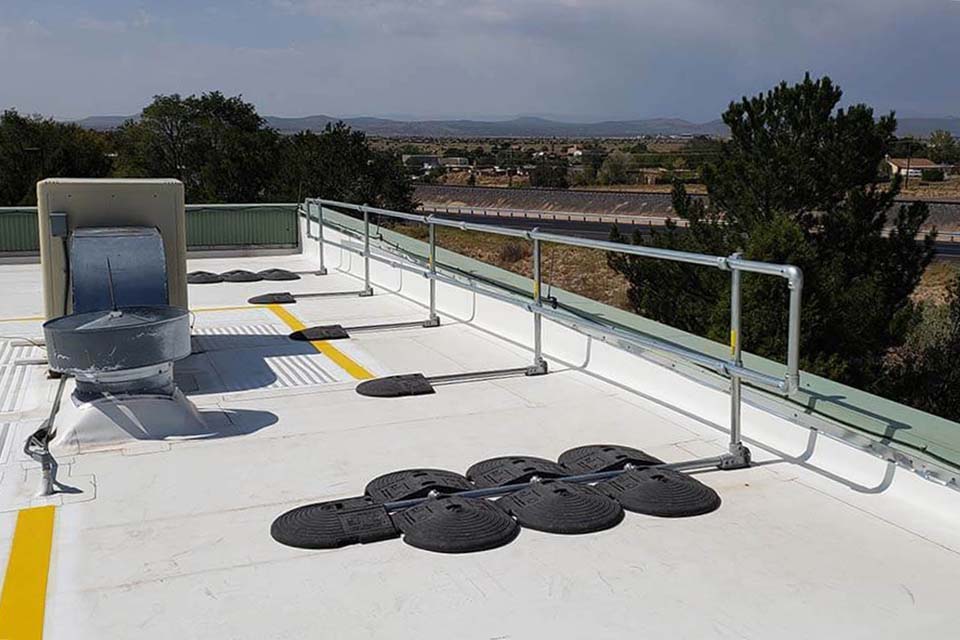
OSHA’s General Industry standard applies to a wide range of environments, from loading docks to rooftop skylights, requiring fall protection for any work surface 4 feet or more above a lower level. An important exception exists when working above dangerous equipment, such as chemical vats or electrical machinery, where protection is required regardless of height, since these hazards can cause serious injury upon contact.
Even in situations not specifically outlined by OSHA, the 4-foot rule still applies. Employers can choose from several protection methods, including guardrails, personal fall protection systems, or safety netting. However, safety netting is generally limited to construction work, and personal fall protection systems must be installed, designed, and used under the supervision of a qualified person
What are the Dimensions of OSHA Guardrail?
The following is an excerpt from OSHA 1910.29 (b) that covers the responsibility for fall protection on working and walking surfaces. Please review the full code for further information.
1910.29(b)
Guardrail systems. The employer must ensure guardrail systems meet the following requirements:
1910.29(b)(1)
The top edge height of top rails, or equivalent guardrail system members, are 42 inches (107 cm), plus or minus 3 inches (8 cm), above the walking-working surface. The top edge height may exceed 45 inches (114 cm), provided the guardrail system meets all other criteria of paragraph (b) of this section (see Figure D-11 of this section).
1910.29(b)(2)
Midrails, screens, mesh, intermediate vertical members, solid panels, or equivalent intermediate members are installed between the walking-working surface and the top edge of the guardrail system as follows when there is not a wall or parapet that is at least 21 inches (53 cm) high:
1910.29(b)(2)(i)
Midrails are installed at a height midway between the top edge of the guardrail system and the walking-working surface;
1910.29(b)(2)(ii)
Screens and mesh extend from the walking-working surface to the top rail and along the entire opening between top rail supports;
1910.29(b)(2)(iii)
Intermediate vertical members (such as balusters) are installed no more than 19 inches (48 cm) apart; and
1910.29(b)(2)(iv)
Other equivalent intermediate members (such as additional midrails and architectural panels) are installed so that the openings are not more than 19 inches (48 cm) wide.
Here’s What OSHA Really Means
The 42” measurement is from the walking surface to the top of the rail, not the roof membrane or insulation. Many installations are cited because measurements are taken from the wrong point.
OSHA requires guardrails to have a top rail height of 42 inches, measured from the working surface to the top edge, with a tolerance of plus or minus 3 inches as long as the system remains compliant. Each guardrail must also include a midrail, unless a wall or parapet at least 21 inches high provides equivalent protection. The midrail should be positioned midway between the top rail and the walking surface.
To prevent large openings, no gap between horizontal or vertical members can exceed 19 inches. This means that taller guardrails—such as those around 45 inches—may require additional midrails, or vertical members spaced no more than 19 inches apart, to maintain compliance and ensure adequate fall protection.
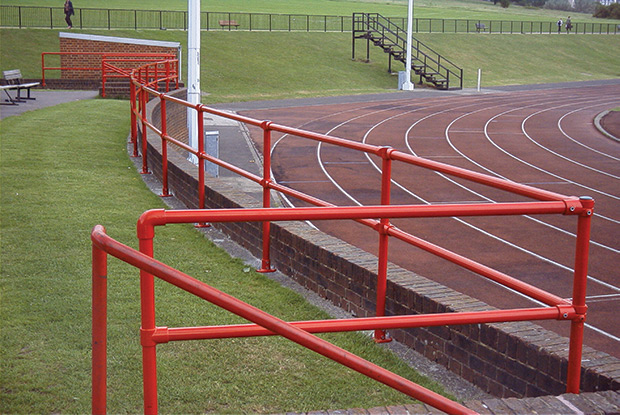
How Strong Does OSHA Railing Have to Be?
The following is an excerpt from OSHA 1910.29 (b) that covers the responsibility for fall protection on working and walking surfaces. Please review the full code for further information.
1910.29(b)(3)
Guardrail systems are capable of withstanding, without failure, a force of at least 200 pounds (890 N) applied in a downward or outward direction within 2 inches (5 cm) of the top edge, at any point along the top rail.
1910.29(b)(4)
When the 200-pound (890-N) test load is applied in a downward direction, the top rail of the guardrail system must not deflect to a height of less than 39 inches (99 cm) above the walking-working surface.
1910.29(b)(5)
Midrails, screens, mesh, intermediate vertical members, solid panels, and other equivalent intermediate members are capable of withstanding, without failure, a force of at least 150 pounds (667 N) applied in any downward or outward direction at any point along the intermediate member.
Here’s What OSHA Really Means
The 200-lb load test must hold in any direction and not just downward pressure. Side-load failures are a common citation.
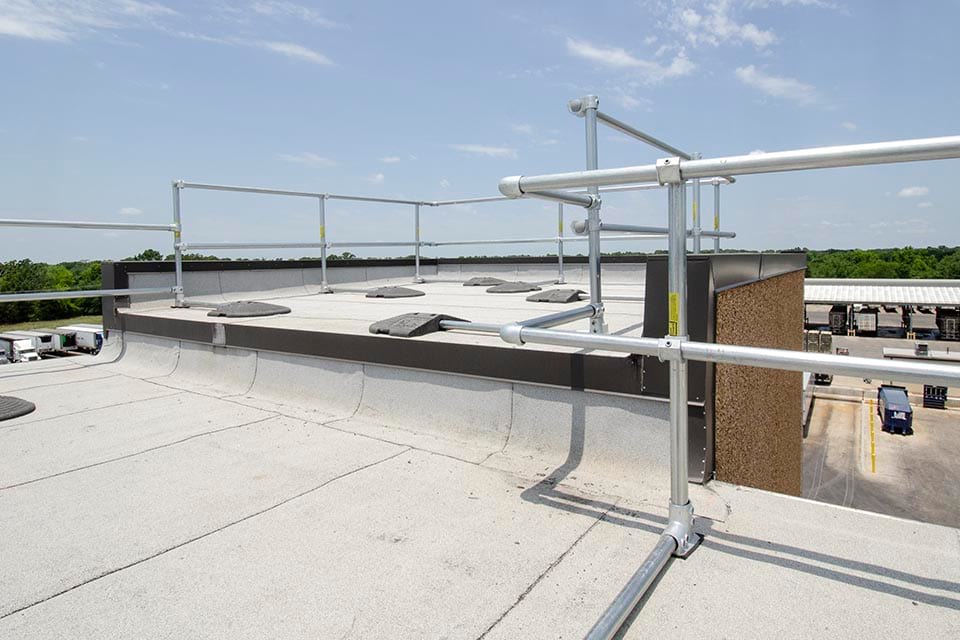
OSHA guardrails must meet specific load requirements for both the top and midrails. The top rail must withstand at least 200 pounds of force applied in either the outward (toward the hazard) or downward (toward the surface) direction, and it cannot deflect below 39 inches in height when that force is applied.
Midrails follow the same principle but are only required to resist 150 pounds of force in those same directions. Together, these strength standards ensure that guardrails provide reliable protection against falls and impacts in industrial and general workplace settings.
Other OSHA Railing Details: Midrails, Toe Boards, and Materials
The following is an excerpt from OSHA 1910.29 (b) that covers the responsibility for fall protection on working and walking surfaces. Please review the full code for further information.
1910.29(b)(6)
Guardrail systems are smooth-surfaced to protect employees from injury, such as punctures or lacerations, and to prevent catching or snagging of clothing.
1910.29(b)(7)
The ends of top rails and midrails do not overhang the terminal posts, except where the overhang does not pose a projection hazard for employees.
1910.29(b)(8)
Steel banding and plastic banding are not used for top rails or midrails.
1910.29(b)(9)
Top rails and midrails are at least 0.25-inches (0.6 cm) in diameter or in thickness.
1910.28(c)
Protection from falling objects. When an employee is exposed to falling objects, the employer must ensure that each employee wears head protection that meets the requirements of subpart I of this part. In addition, the employer must protect employees from falling objects by implementing one or more of the following:
1910.28(c)(1)
Erecting toeboards, screens, or guardrail systems to prevent objects from falling to a lower level;
Here’s What OSHA Really Means
Smooth finishes prevent clothing or gear from snagging, especially important in high-traffic areas like rooftops and platforms. Galvanized or powder-coated steel is OSHA’s preferred long-term material because it resists corrosion.
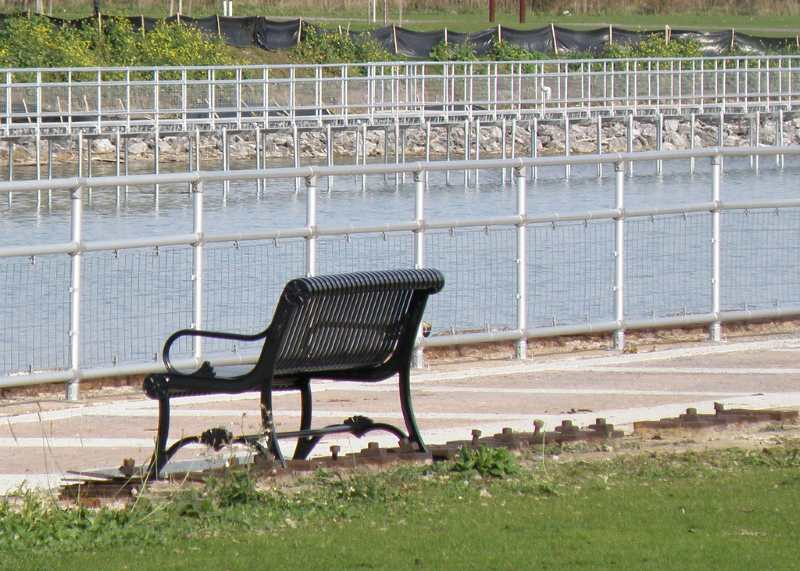
OSHA-compliant guardrails must be designed to protect users from injuries and snags. This includes eliminating sharp edges, punctures, or projections, and ensuring clothing cannot catch on the railing. Top and midrails should terminate securely into posts, walls, or other surfaces to avoid hazards caused by incomplete installation, corrosion, or broken components. In situations where employees are at risk from falling objects, a toeboard should also be installed to prevent tools, debris, or other materials from causing harm.
Guardrails can be made from materials such as galvanized steel, aluminum, or wood, but steel or plastic banding is not allowed. Materials must have a minimum thickness or diameter of ¼ inch, and gaps between members should not exceed 19 inches. In summary: avoid projections, lacerations, and punctures; prevent clothing snags; use proper materials with at least ¼-inch thickness; avoid banding; and add a toeboard where there is a risk of falling objects.
What Railing Does OSHA Require for Ramps and Stairs?
The following is an excerpt from OSHA 1910.28 (b) that covers the responsibility for fall protection on working and walking surfaces. Please review the full code for further information.
1910.28(b)(11)(i)
Each employee exposed to an unprotected side or edge of a stairway landing that is 4 feet (1.2 m) or more above a lower level is protected by a guardrail or stair rail system;
1910.28(b)(11)(ii)
Each flight of stairs having at least 3 treads and at least 4 risers is equipped with stair rail systems and handrails as follows: (Table D-2: Stairway Handrail Requirements)
1910.29(b)(14)
Guardrail systems on ramps and runways are installed along each unprotected side or edge.
1910.29(b)(15)
Manila or synthetic rope used for top rails or midrails are inspected as necessary to ensure that the rope continues to meet the strength requirements in paragraphs (b)(3) and (5) of this section.
Here’s What OSHA Really Means
OSHA uses “stair rail system” to describe a guardrail for stairs. The top of the stair rail can double as a handrail if it’s 36–38” high and easy to grasp.
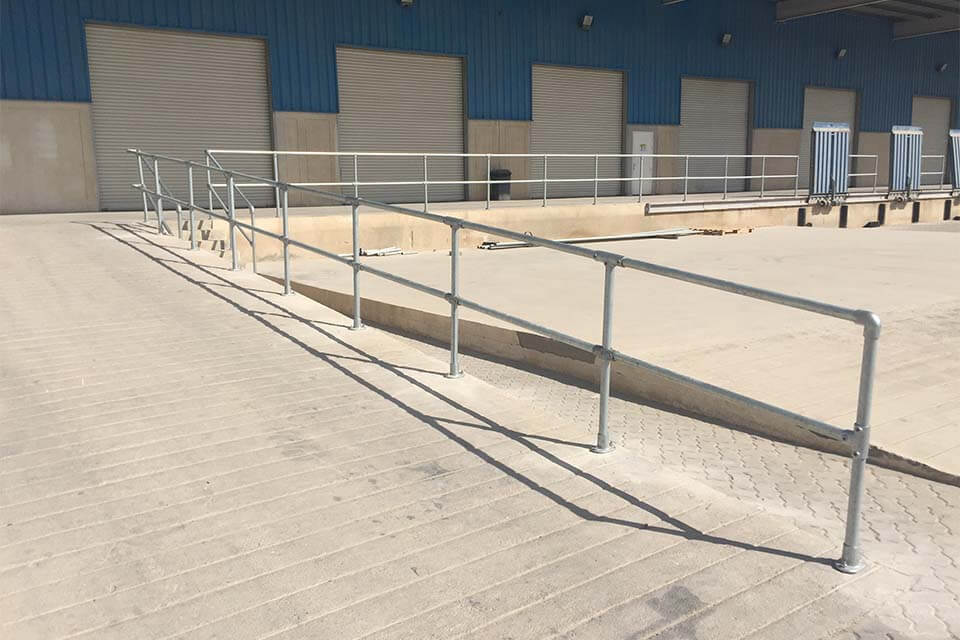
OSHA requires guardrails on any landing that is 4 feet or more above a lower level, consistent with general industry standards. Additionally, stairs with four or more steps, including the landing, must have a stair rail system along with a handrail for employee safety.
A stair rail system functions as a guardrail for stairs, preventing falls to lower levels, while a handrail provides a secure handhold for users. The handrail and the top rail of the stair rail system can be the same component if they meet OSHA’s design requirements. In summary: landings 4 feet or higher need guardrails, and stairs with four or more steps require both a stair rail system and a handrail.
What are OSHA Handrail Design Requirements?
The following is an excerpt from OSHA 1910.29 (f) that covers the responsibility for fall protection on working and walking surfaces. Please review the full code for further information.
1910.29(f)(1)
Height criteria.
1910.29(f)(1)(i)
Handrails are not less than 30 inches (76 cm) and not more than 38 inches (97 cm), as measured from the leading edge of the stair tread to the top surface of the handrail (see Figure D-12 of this section).
1910.29(f)(1)(ii)
The height of stair rail systems meets the following:
1910.29(f)(1)(ii)(A)
The height of stair rail systems installed before January 17, 2017 is not less than 30 inches (76 cm) from the leading edge of the stair tread to the top surface of the top rail; and
1910.29(f)(1)(ii)(B)
The height of stair rail systems installed on or after January 17, 2017 is not less than 42 inches (107 cm) from the leading edge of the stair tread to the top surface of the top rail.
1910.29(f)(1)(iii)
The top rail of a stair rail system may serve as a handrail only when:
1910.29(f)(1)(iii)(A)
The height of the stair rail system is not less than 36 inches (91 cm) and not more than 38 inches (97 cm) as measured at the leading edge of the stair tread to the top surface of the top rail (see Figure D-13 of this section); and
1910.29(f)(2)
Finger clearance. The minimum clearance between handrails and any other object is 2.25 inches (5.7 cm).
1910.29(f)(3)
Surfaces. Handrails and stair rail systems are smooth-surfaced to protect employees from injury, such as punctures or lacerations, and to prevent catching or snagging of clothing.
1910.29(f)(4)
Openings in stair rails. No opening in a stair rail system exceeds 19 inches (48 cm) at its least dimension.
1910.29(f)(5)
Handhold. Handrails have the shape and dimension necessary so that employees can grasp the handrail firmly.
1910.29(f)(6)
Projection hazards. The ends of handrails and stair rail systems do not present any projection hazards.
1910.29(f)(7)
Strength criteria. Handrails and the top rails of stair rail systems are capable of withstanding, without failure, a force of at least 200 pounds (890 N) applied in any downward or outward direction within 2 inches (5 cm) of any point along the top edge of the rail.
Here’s What OSHA Really Means
The handrail height range (30–38”) gives flexibility for design, but the key is continuous grip. Rails must be smooth and unbroken along the full length of stairs or ramps.
OSHA handrails should be 30–38 inches in height, measured from the nose of the step, while stair rail systems should be 42 inches. The top rail of a stair rail system can serve as the handrail if its height is between 36 and 38 inches. Handrails installed before 2017 can be 30 inches or higher, but any replacements or modifications must meet current standards. Handrails must have at least 2¼ inches of clearance from obstructions, a smooth surface to prevent snagging, and be easy to grasp.
Stair rail systems must have no gaps of 19 inches or more in their least dimension, whether horizontal or vertical, and both handrails and stair rail systems must withstand 200 pounds of force. Ends should not extend beyond posts in a way that creates projection hazards. In summary: handrails should be 30–38 inches, smooth, graspable, and strong; stair rail systems should be 42 inches (or 36–38 inches if the top rail is the handrail), gap-compliant, and equally sturdy, with ends properly terminated to avoid hazards.
Speak with an Expert Today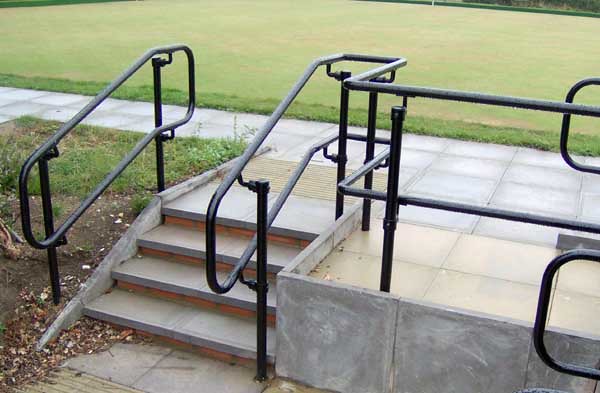
Guardrail vs Handrails. What’s the Difference?

Guardrails prevent falls: Required on open edges, rooftops, and platforms. Must be 42 inches ± 3 inches high per OSHA 1910.29(b)
Handrails provide support: Installed on stairs, ramps, or walkways where workers need balance assistance. Must be 30–38 inches high per OSHA 1910.29(f).
Both are required for full OSHA compliance, depending on the work area.
Speak with an Expert About Guardrails or HandrailsWhat’s Different for Guardrail with OSHA Construction Code 1926?
The following is an excerpt from OSHA 1926.501 that covers the responsibility for fall protection on working and walking surfaces. Please review the full code for further information.
1926.501(b)(1)
"Unprotected sides and edges." Each employee on a walking/working surface (horizontal and vertical surface) with an unprotected side or edge which is 6 feet (1.8 m) or more above a lower level shall be protected from falling by the use of guardrail systems, safety net systems, or personal fall arrest systems.
1926.501(b)(9)(ii)
Each employee reaching more than 10 inches (25 cm) below the level of the walking/working surface on which they are working, shall be protected from falling by a guardrail system, safety net system, or personal fall arrest system.
Note: Bricklaying operations performed on scaffolds are regulated by subpart L - Scaffolds of this part.
The following is an excerpt from OSHA 1926.502 that covers the responsibility for fall protection on working and walking surfaces. Please review the full code for further information.
1926.502(b)(9)
Top rails and midrails shall be at least one-quarter inch (0.6 cm) nominal diameter or thickness to prevent cuts and lacerations. If wire rope is used for top rails, it shall be flagged at not more than 6-foot intervals with high-visibility material.
1926.502(d)(23)
Personal fall arrest systems shall not be attached to guardrail systems, nor shall they be attached to hoists except as specified in other subparts of this Part.
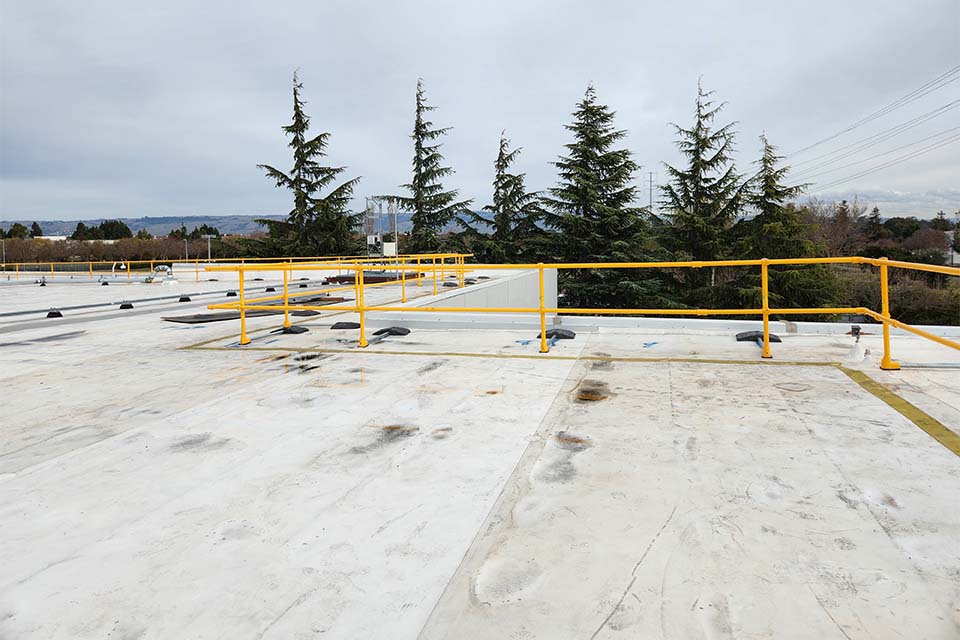
OSHA’s Construction standards differ from General Industry standards in several ways, with the most notable being the guardrail height requirement, which increases from 4 feet to 6 feet. These standards apply across construction scenarios, including roof openings and leading edges, ensuring fall protection is maintained throughout the site.
Additionally, fall protection is required whenever an employee is reaching 10 inches or more below the working surface, regardless of the height of the edge. While guardrail thickness remains the same, if wire rope is used, it must include high-visibility flags spaced no more than 6 feet apart to ensure workers can easily see the barrier.
A very important note is that guardrail should not be used as a part of a personal fall arrest system. 200 pounds of force is very different than the 5000 pounds required for personal fall arrest systems.
In Summary:
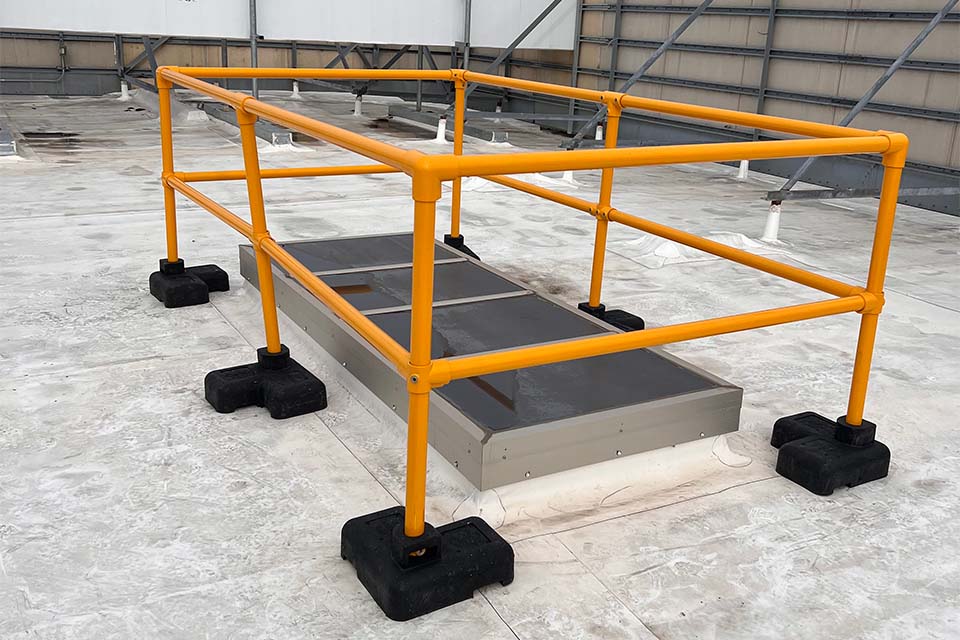
What’s Different for Guardrail with Cal-OSHA?
The following is an excerpt from California Code Title 8 Section 3210 that covers the responsibility for fall protection on working and walking surfaces. Please review the full code for further information.
3210 Guardrails at Elevated Locations
(a) Buildings. Guardrails shall be provided on all open sides of unenclosed elevated work locations, such as: roof openings, open and glazed sides of landings, balconies or porches, platforms, runways, ramps, or working levels more than 30 inches above the floor, ground, or other working areas of a building as defined in Section 3207 of the General Industry Safety Orders. Where overhead clearance prohibits installation of a 42-inch guardrail, a lower rail or rails shall be installed. The railing shall be provided with a toeboard where the platform, runway, or ramp is 6 feet or more above places where employees normally work or pass and the lack of a toeboard could create a hazard from falling tools, material, or equipment.
The following is an excerpt from California Code Title 8 Section 3209 that covers the responsibility for fall protection on working and walking surfaces. Please review the full code for further information.
3209 Standard Guardrails
(a) A standard guardrail shall consist of top rail, midrail or equivalent protection, and posts, and shall have a vertical height within the range of 42 inches to 45 inches from the upper surface of the top rail to the floor, platform, runway, or ramp level. (Note: the permissible tolerance on height dimensions is one inch). The top rail shall be smooth-surfaced throughout the length of the railing. The midrail shall be approximately halfway between the top rail and the floor, platform, runway, or ramp. The ends of the rails shall not overhang the terminal posts, except where such overhang does not constitute a projection hazard. (Title 24, Part 2, Section 2-1716(a)).
(b) All guardrails and other permissible types, including their connections and anchorage, shall be designed for a live load of 20 pounds per linear foot applied either horizontally or vertically downward at the top rail. Dimensional details of railing members of a few types of construction which comply with this strength requirement are given hereinafter in subsection (c).
(c) The following are some acceptable guardrail specifications: other combinations will be accepted as long as equivalent strength and protection are maintained.
- In wooden construction, the posts to be of at least 2-inch by 4-inch nominal material spaced not to exceed 6 feet, the top rails to be smooth with corners rounded and not less than 2-inch by 4-inch nominal material. The posts may be spaced on 8-foot centers if the top rails consist of double 1-inch by 4-inch nominal boards, provided that 1 board is fastened in a flat position on top of the posts and the other is fastened in an edge-up position to the inside of the posts and the side of the top board. Single midrails, where permitted, shall be not less than 2-inch by 4-inch nominal material and installed on the contact side of the guardrail.
- If constructed of standard metal pipe, the top rails and single midrail, where permitted, to be 1 1/2-inch outside diameter or larger. The posts to be 1 1/2-inch outside diameter or larger, the spacing not to exceed 8 feet.
- Guardrails installed on or before May 26, 2011. If constructed of structural metal, the top rails to be angle iron of at least 2-inch by 2-inch by 1/4-inch angles or other metal shapes of equivalent bending strength; and the single midrail, where permitted, to be iron or steel of at least 2-inch by 2-inch by 1/4-inch angles or other metal shapes of equivalent strength. The posts to be angle iron of at least 2-inch by 2-inch by 1/4-inch stock, the spacing not to exceed 8 feet.
- Guardrails installed after May 26, 2011. If constructed of structural metal, the top rails to be angle iron of at least 2-inch by 2-inch by 3/8-inch angles or other metal shapes of equivalent bending strength; and the single midrail, where permitted, to be iron or steel of at least 2-inch by 2-inch by 3/8-inch angles or other metal shapes of equivalent strength. The posts to be angle iron of at least 2-inch by 2-inch by 3/8-inch stock, the spacing not to exceed 8 feet.
California OSHA (Cal-OSHA) differs from Federal OSHA in several key ways. For non-government worksites in California, guardrails are required for surfaces >30 inches or more above a lower level, compared to 4 feet under Federal OSHA. Toeboards to prevent falling objects are only required at heights of 6 feet or more. Additionally, Cal-OSHA requires guardrails to withstand 20 pounds of force per linear foot, applying to the entire guardrail rather than just the top rail.
Cal-OSHA also specifies slightly different height and material requirements. Guardrails should be 42–45 inches tall, with post spacing no greater than 8 feet. Material guidelines include 2×4 nominal wood, 1.5-inch diameter steel pipe, or 2×2-inch angle iron with 3/8-inch thickness. In summary: guardrails for surfaces 30 inches or higher, 42–45 inches tall, 20 pounds per linear foot load, proper material sizing, and post spacing no more than 8 feet.
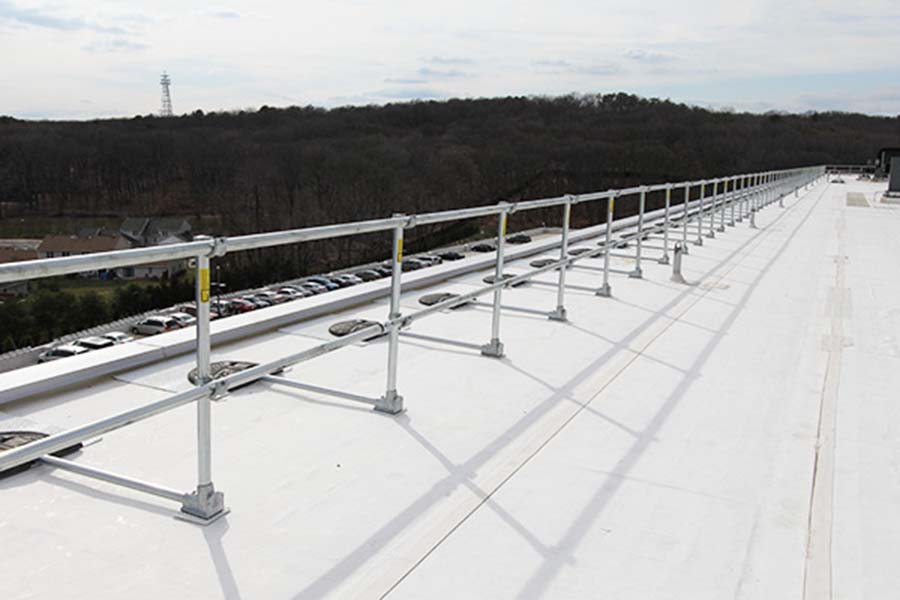
Applicable Codes & Requirements
Here is a list of the various codes and requirements that are important for guardrail. There are also come included codes that are not referenced above and may or may not apply to your situation.
Federal OSHA General Industry
Federal OSHA Construction Code
California OSHA
Common OSHA Mistakes

These are a few common mistakes that can occur with existing guardrail or when purchasing/installing your own guardrail.
- Guardrails installed below 39” due to deflection or sag
- Missing midrails or toe boards on elevated surfaces
- Using residential-grade materials not rated for 200 lbs
- Forgetting to include handrails on access stairs or ramps
- Failing to perform regular inspection and maintenance
Speak with a fall protection expert today to avoid these potentially costly mistakes.
OSHA Railing FAQs
At what height does OSHA require railing or fall protection?
What are OSHA guardrail requirements?
How much weight should safety railings support?
What is OSHA compliant railing vs what is grandfathered into OSHA compliance?
Does OSHA require railing to attach to a structure or building?
What are the OSHA requirements for railing post spacing?
What does OSHA require for the diameter of the top rails and mid-rails?
How far apart can the vertical rails or balusters be apart?
When is a toeboard required by OSHA?
How high should a stair railing be?
What are industrial stair railing requirements?
Simplified Safety was very knowledgeable in terms of OSHA requirements and provided a product that would satisfy OSHA requirements. The customer service was great.
-Christopher, Timberline Communications Inc.