How to Perform a Rooftop Safety Audit (OSHA Checklist)
Falls from height are still one of the leading causes of workplace death in the United States, and the roof is where a lot of general industry workers get exposed to that risk without realizing it. Roof access usually isn't part of someone's daily routine, which is exactly why the hazards get overlooked. Nobody's thinking hard about a skylight or an unguarded edge when they're only up there twice a year to service an HVAC unit.
That occasional-access pattern is the problem. Think about everything that actually happens on a commercial roof: HVAC maintenance, security and camera servicing, gutter cleaning, snow removal, window washing prep, solar panel work. Every one of those is a person on your roof, exposed to a fall, often with no plan in place.
A rooftop safety audit is how you get ahead of it. Below is the walkthrough we use, broken into the five areas that matter most, followed by the other hazards worth checking and a printable checklist you can take up on the roof with you. Every roof has its own quirks, but these are the areas that catch the most problems.
1. Access points
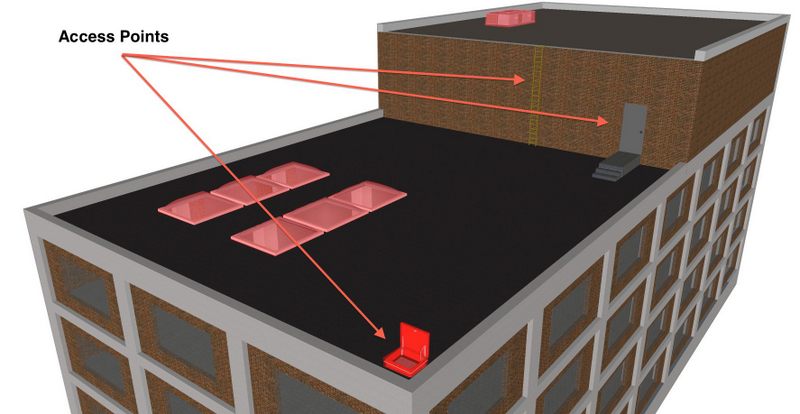
Start with how people actually get onto the roof. There are usually three ways in: roof hatches, walk-out doors, and exterior stairs or fixed ladders. Each has its own set of things to check.
- Is there a guardrail around the roof hatch? When the hatch is open, it's a hole in the roof, and OSHA treats it as a fall hazard that needs protection on every side.
- Is the hatch dangerously close to a roof edge, so someone stepping out has a fall exposure right away?
- Are there trip hazards right around walk-out doors, where people step out without looking down?
- Are permanently attached ladders in good repair, rust-free, and securely fastened to the wall?
- Is there a self-closing gate at the top of ladders and at hatch openings? A chain or a removable bar does not meet the standard.
- If people access the roof at night, is there enough lighting to do it safely?
- Are access points secured so unauthorized people can't wander up? Doors locked, exterior ladders and stairs not climbable by just anyone.
2. Unprotected edges and open sides
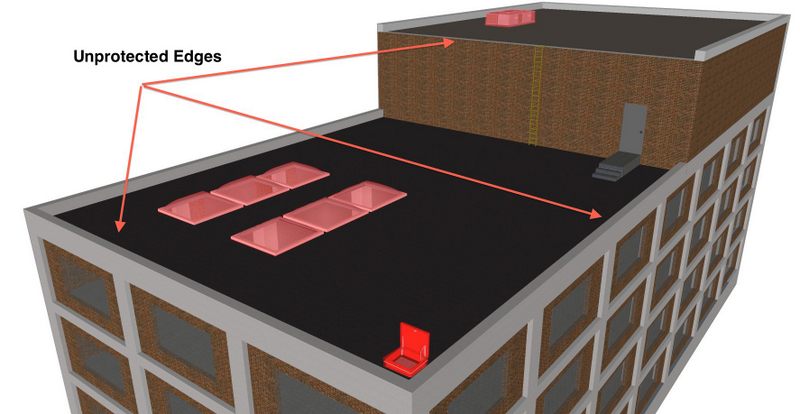
The roof edge is the obvious one. It's where everybody expects a hazard, which sometimes means it gets less scrutiny than it should, not more. Here's what to actually look at.
- Are there any roof-to-roof height changes greater than 4 feet? Under OSHA 1910.28(b)(1), an unprotected side or edge 4 feet or more above a lower level needs fall protection. That includes interior drops between roof sections, not just the outer perimeter.
- Are the edges people work near or walk past actually guarded, or has everyone just been told to be careful?
- Are there parapets shorter than 42 inches? A low parapet is not a guardrail. If it's under the 42-inch guardrail height, the edge still needs protection.
- Are existing railings and fall arrest anchors in good working order, or are they corroded, loose, or past inspection?
- Is there a toeboard where tools could get kicked over an edge onto people below?
When it comes to fixing an edge hazard, the safest option is always to eliminate it. Full perimeter protection with a non-penetrating roof guardrail takes the fall exposure off the table entirely and doesn't rely on anyone remembering to clip in. That's not always practical for every roof, though. When it isn't, the next step is spot protection: guard the specific areas where a roof edge is near a working or walking surface. And where a railing genuinely can't go, a horizontal lifeline with personal fall arrest can protect workers near the edge. Each approach has tradeoffs, and it's worth understanding the pros and cons of each fall protection system before deciding.
What OSHA actually requires near a low-slope roof edge
This is the part that gets stated wrong more than any other, so here's the real rule. OSHA 1910.28(b)(13) breaks work near a low-slope roof edge into three zones based on distance from the edge:
- Less than 6 feet from the edge: a guardrail, safety net, travel restraint, or personal fall arrest system is required. No warning-line-only option here.
- 6 feet to less than 15 feet from the edge: the same protection systems are required, but a designated area marked with a warning line is allowed if the work is both infrequent and temporary.
- 15 feet or more from the edge: you can use any of the protection systems or a designated area. You may skip fall protection only if the work is both infrequent and temporary and you enforce a rule keeping people at least 15 feet back from the edge.
The takeaway for an audit: distance from the edge changes what's allowed, and "we put up a warning line" is not automatically compliant. It depends on how far from the edge the work is and whether the work is infrequent and temporary. For anything regular or ongoing, a guardrail is usually the cleanest way to stay compliant without managing exceptions.
3. Walking paths

On a roof, the shortest path between two points usually isn't the safest one. People take the fastest route from A to B by instinct, and on a roof that instinct can walk them right past an unguarded edge or across a slippery surface. Sometimes the safer move is to mark a longer route that keeps people away from hazards.
- Are safe walking paths clearly marked? And if you get snow, will the path still be visible when the roof is covered?
- Does the path have to cross obstacles like pipes, conduit, or roofs of different heights? Those crossings need their own solution, usually a crossover platform.
- Does the path come closer than 15 feet to an unprotected edge? If so, revisit the edge-protection rules above.
- Does the surface get slippery in rain, ice, or morning dew?
- Are people walking on an uneven surface like a standing seam or ribbed metal roof, where footing is unreliable?
A marked walkway with a level walking surface cuts the risk considerably. One field tip: if you're not sure what route people are actually taking, look for footprints or wear marks after a rain or snow. You'll often find workers cutting across places you'd never expect, and usually closer to the edge than anyone would like.
4. Rooftop equipment
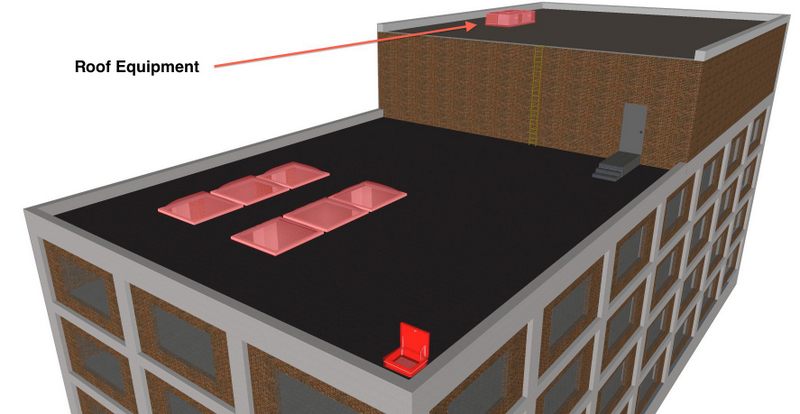
People are on the roof for a reason, and most of the time that reason is a piece of equipment. HVAC units, exhaust fans, sensors, and other rooftop equipment all need regular servicing. It's easy to assume that's the contractor's problem to solve for their own crew, but that assumption doesn't hold up. As the building owner or operator, you have a duty to provide a safe workplace, and OSHA and your insurer will both hold you to it even when the person on the roof works for someone else.
- What equipment actually needs to be accessed up there, and how often?
- Is any of it close to the roof edge? If servicing it puts a worker near an unprotected edge, the edge-protection distance rules apply.
- Could someone fall into or through the equipment itself?
- Does getting to it involve stepping over pipes or cables, creating a trip hazard?
- Is the equipment taller than the worker needs to reach? If they have to climb it, they need protection at that height too.
5. Openings
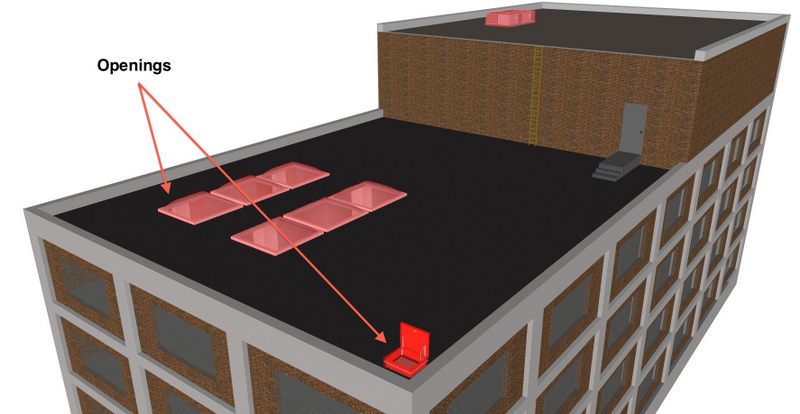
It sounds odd to talk about openings in a roof, since keeping the weather out is the whole point of one. But there are more holes up there than most people realize, and they're some of the most dangerous hazards on the roof because they don't look like hazards.
- Are skylights guarded? OSHA classifies a skylight as a hole in the roof. A person can fall through a skylight that looks solid, and these falls are frequently fatal. Under 1910.28(b)(3), any hole 4 feet or more above a lower level, skylights included, needs a cover, guardrail, travel restraint, or personal fall arrest.
- Are smoke vents guarded? They aren't built to hold a person's weight, and your fire marshal may require them protected in the open position for firefighters accessing the roof during a fire.
- Are roof hatches guarded? Same point as the access section: an open hatch is a genuine fall hazard.
- Are there smaller openings a tool or piece of equipment could drop through and hurt someone below?
Other hazards worth checking
This audit focuses on fall hazards because those are the ones that kill people, but a thorough rooftop assessment looks at more than falls.
- Hazardous materials. Anything venting or collecting on the roof surface that a worker could be exposed to?
- Weather conditions. Different roof surfaces behave differently in rain, ice, and heat. Spell out what conditions have to be met before anyone goes up.
- Controlled access. Who's allowed up there? Is anyone going up alone? Is there a sign-in log or a check-in system so someone knows if a worker doesn't come back down?
- Fall protection plan. A written plan isn't optional for at-height work, and it needs to include a rescue plan. Getting a fallen, suspended worker down quickly is its own emergency.
- Anything unique to your roof. Every roof has quirks. The odd one-off hazard is often the one nobody wrote down.
This walkthrough is a strong starting point, but it won't catch every hazard specific to your building. OSHA requires that a competent person, someone with the training and authority to identify hazards and correct them, evaluate your rooftop. If you'd like a hand, our team offers remote and on-site rooftop audits and can give you direction for your specific roof.
How to fix what you found
An audit only matters if it leads to action. Once you've walked the roof and marked what fails, here's how each type of hazard actually gets solved. Every one of these is a passive system where possible, meaning it protects everyone who comes up without relying on training or remembering to clip in.
- Unprotected roof edges: a KeeGuard non-penetrating roof guardrail for flat roofs, or a mounted or parapet-mounted guardrail where the roof structure allows it. Both take the fall exposure off the table without anyone wearing gear.
- Skylights and roof openings: skylight screens or skylight guardrail, depending on whether you want a cover over the opening or a railing around it.
- Open roof hatches: a roof hatch guardrail with an integrated self-closing gate protects the opening on every side.
- Obstacles in the walking path: a crossover platform or stairs to get over pipes, ductwork, and height changes safely, or a rooftop walkway to create a level, marked path across an uneven surface.
- Ladder and hatch access points: a self-closing safety gate at the top of every ladder and access opening.
- Areas where a railing won't work: where a guardrail genuinely isn't feasible, anchor points and a horizontal lifeline provide personal fall protection near the edge. This is the last resort after passive options, since it depends on training and worker compliance.
Not sure which mix is right for your roof? That's exactly what a professional rooftop audit sorts out.
Your rooftop safety audit checklist
Here's the whole thing condensed into a checklist you can take up on the roof. Use the button below to print it or save it as a PDF, walk the roof, and mark anything that fails so you have a punch list to work from.
Access points
- □ Guardrail around every roof hatch
- □ Self-closing gate at ladder tops and hatch openings (not a chain)
- □ Fixed ladders rust-free and securely attached
- □ No trip hazards at walk-out doors
- □ Adequate lighting for night access
- □ Access points secured against unauthorized entry
Edges and open sides
- □ All roof-to-roof drops over 4 feet protected
- □ Worked-near and walked-past edges guarded
- □ Parapets under 42 inches treated as unprotected edges
- □ Existing railings and anchors inspected and in working order
- □ Toeboard where tools could fall on people below
- □ Edge-distance rules (6 ft / 15 ft) applied correctly to each work area
Walking paths
- □ Safe paths clearly marked, visible even in snow
- □ Obstacle crossings (pipes, height changes) have a safe solution
- □ No path runs closer than 15 feet to an unprotected edge
- □ Slippery-when-wet surfaces identified
- □ Uneven surfaces (standing seam, rib) addressed with a walkway
Rooftop equipment
- □ All serviced equipment identified, with access frequency noted
- □ Equipment near the edge has appropriate edge protection
- □ No fall-into or fall-through exposure at the equipment
- □ Trip hazards on the approach cleared or bridged
- □ Protection in place if workers must climb the equipment
Openings
- □ All skylights guarded with a screen, cage, or railing
- □ Smoke vents guarded (check fire marshal requirements)
- □ Roof hatches guarded
- □ Smaller tool/equipment openings covered
Program and other hazards
- □ Hazardous materials on the roof surface identified
- □ Weather conditions for roof access defined
- □ Controlled access and a sign-in or check-in system in place
- □ Written fall protection plan, including a rescue plan
- □ Roof-specific hazards documented
- □ A competent person has reviewed the roof
Frequently asked questions
Sources
- OSHA 29 CFR 1910.28, Duty to Have Fall Protection and Falling Object Protection (including b(3) Holes and b(13) Work on Low-Slope Roofs)
- OSHA 29 CFR 1910.29, Fall Protection Systems and Falling Object Protection Criteria and Practices
- OSHA 29 CFR 1926.502, Fall Protection Systems Criteria and Practices (rescue and fall protection plan requirements)
Want a second set of eyes on your roof?
Our fall protection specialists perform remote and on-site rooftop audits and can walk your roof with you, flag what needs attention, and put together a plan to bring it into compliance.


