JavaScript seems to be disabled in your browser. You must have JavaScript enabled in your browser to utilize the functionality of this website.
Who is responsible for your safety? Is it the safety manager? Is it your supervisor? Is it the owner of the company for which you work? Sure, each of these people plays a part in building a framework that allows you to perform your job in a safe working environment, but in the end, the...
Extension ladders: who hasn’t used one to access the roof of their home, praying every moment that it won’t fall back, slip to the side, or just buckle under your weight? A tool so common can still be extremely dangerous and the facts are alarming:
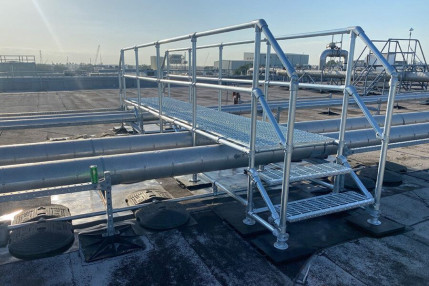
If you are responsible for maintaining rooftop HVAC equipment, you have probably run into a common problem: technicians need to safely cross piping, ductwork, conduit, or elevation changes just to reach the equipment they service every day.
The confusing part is that most buyers do not know...
Certainly, cold weather poses hazards to anybody working outdoors, but the higher you go, the more intense the conditions can get. Workers on the ground are facing different hazards than workers on the roof of an office building, who are facing different hazards than construction workers on...
Maximum Arresting Force (or M.A.F.) is a term you will hear frequently used in association with fall protection, so it’s better to understand the term before you encounter it (if you’ve already encountered it, better late than never!). In simple terms, M.A.F. is exactly what it sounds like:...
Falls cause the most worker fatalities and injuries during rooftop ice and snow removal. Workers can fall off roof edges, through skylights, and from ladders and aerial lifts (OSHA source). If you live in a...
Go to You Tube, search any topic, and you’re bound to come up with videos showing what you’re looking for. Fall protection situations are no exception. With a little searching, you can find videos showing good examples of fall protection, bad examples of fall protection, complete lack of...
Take a look around the neighborhood you live in. How many fences do you see? Probably quite a few, right? And, where you see fences, how many have no gates? I would venture to guess that the answer is “very few if any.” That’s because a fence is put up for a reason: to keep...
We’ve discussed skylights and the associated fall hazards in a number of blog posts, most notably in this article, but our point of view has always been in looking out for the well-being of a company’s employees. That perspective is necessary because, ultimately, a company is responsible...
So, you’ve decided to buy an industrial safety gate! Great! As with any other purchase, there are questions to be answered and options to be selected. Gates, while effective, convenient, relatively inexpensive, and easy-to-install, are not one-size-fits-all. Yes, many gates can each be...
With the coming of warmer temperatures in most of the country comes an increase in construction activity. Unfortunately, if history teaches us anything, with increased construction activity comes increased worker injuries and fatalities. Falls continue to top the list of fatalities in...
OSHA regulations speak in absolutes: there is a hazard or there isn’t a hazard. In reality, though, there are varying degrees of hazards because there are varying degrees of severity and varying degrees of likelihood that an incident will occur. You will see this reflected by OSHA in...
Roof washing is probably never on anybody’s top-5 list of ways to spend an afternoon, but it certainly can become a necessary evil. If it were just a matter of aesthetics, you could almost write it off as vanity and leave your roof to become whatever filthy mess it was destined to...
No safety program is perfect for one simple reason: people aren’t perfect. No matter how many policies you put in place, no matter how much equipment you buy, no matter how much training you do, in the end, you are depending on human beings to implement your safety program, and human...
Updated on December 20, 2018 by Josh Borowiec
Rooftop fall protection seems to be one of the most confusing regulations.
Given the amount of different scenarios, it's easy to miss an important detail – or at least misinterpret one. So, here’s a quick and easy by-the-numbers guide...
Recently, we posted an article on the common hazards found during rooftop HVAC work. In it was stated, “Routes of travel that take you past skylights or near the edge of the roof have now exposed you to fall hazards.” This is not an empty warning. Skylights are a hazard often overlooked...
We often focus here on what you need to do to keep your employees safe and to ensure your company is compliant with the law, but at some point in time, some of you are going to be involved in an OSHA inspection and the outcome may not be as favorable as you’d like. In this post, we’re...
By now, you may have heard: OSHA issued a new final rule in regards to electronic recordkeeping. Great! What the heck does that mean?
Well, funny you should ask, because I’ve got answers!
Just the Facts
Let’s start with the basics. The final rule was issued by OSHA...
Anytime you are tasked to keep someone safe from falling, one decision must be made first. Do I select a Passive System or Active System?
Understanding the difference between passive and active fall protection is a great place to start.
Sometimes you can have the best program on paper, but it doesn’t seem to be translating well to real-world implementation. Maybe your workforce is telling you they like the program, but every time you observe them, they’re breaking the rules. Maybe your supervisory personnel seem...
Option available in footer.